
The ‘rich dukes’ of Bavaria-Landshut
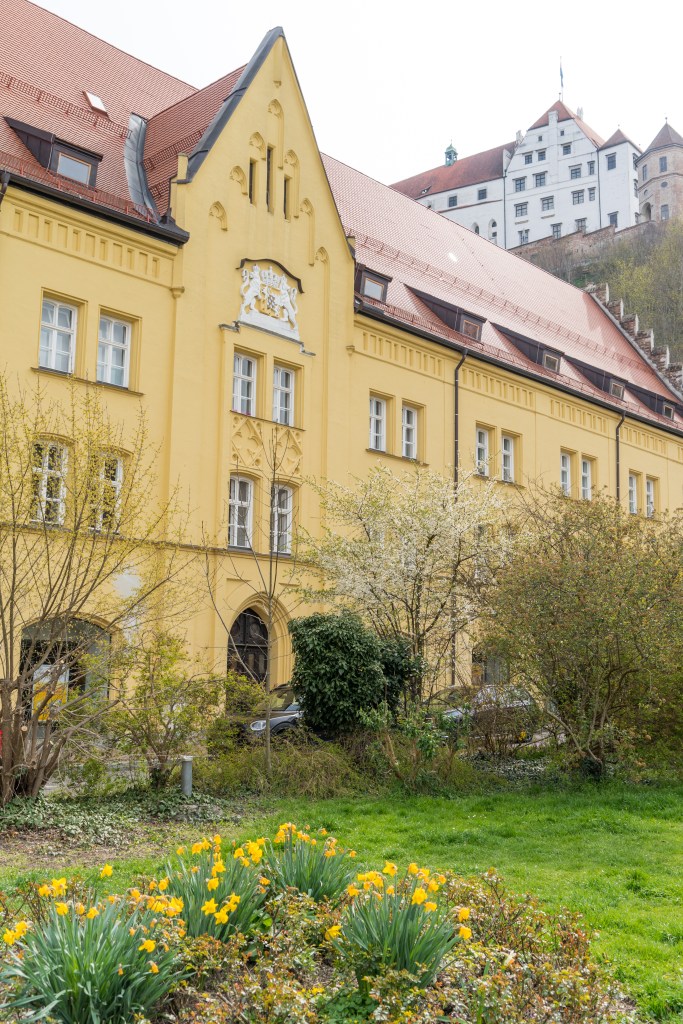
In the middle of the 15th century, Bavaria was still divided into two parts. Of the four Wittelsbach partial duchies created in the course of the land divisions of 1349 and 1392, only Bavaria-Landshut (Lower Bavaria) and Bavaria-Munich (Upper Bavaria) had been able to establish themselves firmly. The Straubing-Holland line had died out in 1425 and Bavaria-Ingolstadt in 1447 because there were no male heirs.
The Bavarian section ruled by the Landshut line was territorially and thus also financially far superior to the Munich section. With the Straubing inheritance and the securing of almost the entire Ingolstadt inheritance, the Landshut dukes had created a solid basis for a self-confident and powerful polity in the empire. The Lower Bavarian duchy thus far surpassed that of the Upper Bavarian line in both scope and importance: around 1450, two-thirds of the Bavarian duchy was in the hands of the Landshut line. This Lower Bavarian territory extended in an almost closed territorial complex with the courts of Rattenberg, Kitzbühl and Kufstein, from the edge of the Alps to the Danube, and in the west to Neuburg and Lauingen into Upper Swabia. Thus it surpassed the long-drawn-out Duchy of Bavaria-Munich, which was separated into two territorial complexes and extended from the edge of the Alps to the Bohemian Forest.
In Bavaria-Landshut, dynastic continuity contributed to the further stabilization of the rule. Only three dukes, Heinrich, Ludwig IX (1450-1479) and Georg (1479-1503), ruled from 1393 to 1503, and the dominion passed in a well-ordered manner to the only surviving son in each case for three generations. Henry, Louis and George were already given the nickname “the rich ones” during their lifetimes – and rightly so. With the exorbitant treasury of the Lower Bavarian duchy, Bavaria-Landshut was one of the financially strongest duchies in the empire and thus represented a significant power. This wealth consisted of 1,200,000 Rhenish gulden in cash assets, jewels of the Burghausen treasure worth about 300,000 Rhenish gulden, enormous grain stocks that were stored and sold at a profit in bad harvest years, and the annual average net income of 64,580 Rhenish gulden.
Irmgard Lackner
Further reading:
Spitzlberger, Georg: Das Herzogtum Bayern-Landshut und seine Residenzstadt 1392-1503, Landshut 1993.
Stauber, Reinhard/Tausche, Gerhard/Loibl, Richard: Niederbayerns Reiche Herzöge (=Hefte zur Bayerischen Geschichte und Kultur 38), Augsburg 2009.
 HistoryCity Apps