
‘Most of their people are foreigners’
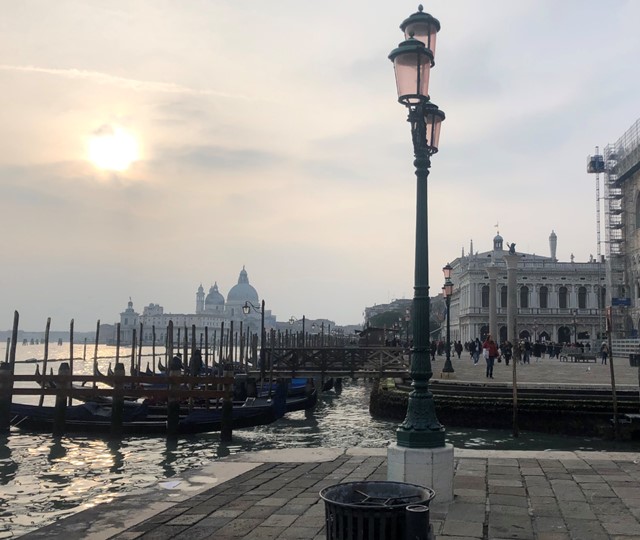
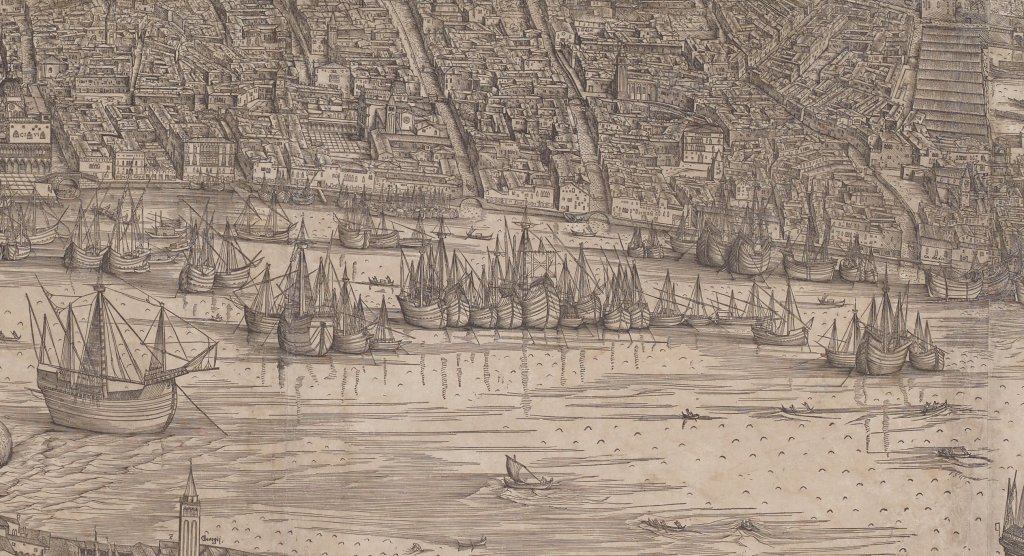
From its beginnings as an outpost of the Byzantine Empire, Venice by the sixteenth century had grown into one of the wealthiest and most powerful independent states in Europe. It did this particularly thanks to its strategic role as a commercial entrepôt where merchants from west and east would meet to trade in luxury goods as well as more everyday commodities. In Elena’s time, the 1570s, the Riva degli Schiavoni would have been a thriving docks, with ships of different sizes lined up one after another, as shown in Jacopo de’ Barbari’s printed view of the city in 1500 (below).
Since the late Middle Ages, Venice had also bolstered its economic and political power thanks to territorial expansion, both northwest onto the Italian mainland and southeast along the coast of what is now Croatia and Greece, including Cyprus and Crete. Increasingly, however, the extension of this vast state brought the Republic of Venice into conflict with the Muslim Ottomans, who had taken over the Byzantine capital of Constantinople in the mid-fifteenth century and were expanding their own empire. Ottoman advances in the Mediterranean forced waves of refugees to flee towards Venice in this period, among them from Venetian colonies like Nauplion, or Napoli di Romania, as the Venetians called it.
Along with many others who came to Venice temporarily or permanently to find work in the city’s booming economy, these refugees contributed to swelling the Venetian population by about fifty per cent between the late fifteenth and the mid-sixteenth century. This made Venice one of the largest and most densely populated cities in Europe, with at least twenty to thirty per cent of urban residents being foreign-born. Indeed, a French ambassador to Venice at this time, Philippe De Comynes, famously commented that “most of their people are foreigners”.
Like all early modern cities, Venice needed migrants in order to grow, and to provide labour for the city’s thriving industries. The Republic took a largely pragmatic approach to the question of immigration – people were generally welcomed if they could benefit the local economy in some way, and if not perceived as a drain on resources or a source of disorder. The rapid growth of the city in the sixteenth century, however, as well as a turbulent broader political, religious, and economic context, also encouraged some xenophobic policies. For example, from 1516 Jews had to live inside the Ghetto area in the northwest of the city. A century later the government decreed that Muslim merchants in Venice had to reside inside their own trading house, the Fondaco dei Turchi. These efforts aimed to allow some of the benefits of migration while limiting contact between urban residents and foreigners of different faiths.
Rosa Salzberg
Further reading
Ravid, Benjamin. “Venice and its Minorities”, in Eric R. Dursteler, ed., A Companion to Venetian History, 1400-1797, Leiden & Boston: Brill, 2013, pp. 449-85.
Arbel, Benjamin. “Venice’s Maritime Empire in the Early Modern Period”, in Eric R. Dursteler, ed., A Companion to Venetian History, 1400-1797, Leiden & Boston: Brill, 2013, pp. 125-253.
Rothman, E. Natalie. Brokering Empire: Trans-Imperial Subjects between Venice and Istanbul. Ithaca: Cornell University Press, 2011.
 HistoryCity Apps