
Church, library, observatory
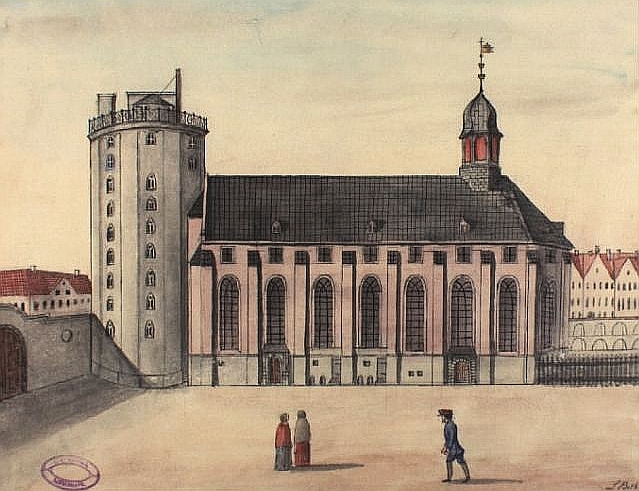
Trinitatis Church and the Round Tower were built by King Christian IV (1577-1648) as rather distinctive buildings. The foundation stone was laid in 1637, the Round Tower was completed in 1642, and the Church and cemetery were ready for use in 1656.
Very unusually for a church building, the Church and tower were designed to accommodate three functions. This was the King’s solution to three of the University’s urgent problems, two of which had nothing to do with ecclesiastical matters. The University needed a church for its students, space for the library’s books, and an observatory where astronomers could study the stars and fulfill the legacy of the world-famous Danish astronomer Tycho Brahe.
In 1635, the King bought three estates opposite the student college, tore them down, and merged the plots into one. On the site, he built the city’s second largest Church – exclusively for the students and professors at the University. A new library for the University was built in the attic above the church hall, and there are indications that the library’s need for space determined the size of the Church. An astronomical observatory was erected at the top of the Round Tower. This meant that the church bells were not hung in the tower but were relegated to the attic above the library. The Church was named Trinitatis, meaning Trinity – Father, Son, and Holy Spirit – but it may also have a reference to the Church’s three functions.
Christian IV liked functional solutions but also wanted to surprise his surroundings. Thus, the Round Tower has several distinctive features that leave many in no doubt that the King himself was deeply involved in its construction. A brick walkway like the one in the Round Tower is found in only a few places, but it makes it easier to get up to the tower, and the King may also have planned to drive to the top.
The Round Tower is adorned by a nine-meter high rebus, designed by the King. It reads: “doctrinam” (Christian doctrine) + a sword (justice) + “dirige” (lead) + “Jehovah” [in Hebrew characters] (God) + a heart + the king’s monogram with crown. It is interpreted – with modern wording – as: God, place the right doctrine and justice into the heart of King Christian IV.
The Church was built for the University, but it bore the King’s colors: the outer walls had bands of yellow and red bricks, as in several of the King’s other buildings, and the library was painted red and yellow.
In addition to the entrance to the Round Tower, there are also four entrance doors to the Church. Only the southern portal, where we meet the app character Niels, is original and is the Church’s only surviving portal from the 17th century.
In 1921, an unknown underground room was discovered beneath the Round Tower’s basement floor. The room was connected to a shaft leading up to the entrance to the library hall, outside the reading room. It was a supposedly secret waste shaft that led to student toilet. As many as nine loads of moldy latrine contents had to be carted away.
The Church could not manage financially with the students alone, and in 1683 it became a parish church for the general public. In 1728, fire destroyed the library, the observatory, and the church furniture, but the walls survived, and the Church was rebuilt.
Rikke Simonsen
Further reading
Jan Steenberg: Trinitatis Kirke, Danmarks Kirker, I. Københavns by, Bd. 2, 1960-65, s. 225-398.
Inger Wiene, Kirsten Sandholt og Jesper Vang Hansen (eds.): Runde Kirke, Taarn og Sogn. Trinitatis gennem 350 år, Nyt Nordisk Forlag, 2006.
 HistoryCity Apps