
The hospitality industry
As well as its large migrant population, a great many people came to Venice for shorter periods of time, be it days, weeks, or months. Most of these visitors and temporary migrants came to work, although some, such as pilgrims on their way to the Holy Land, passed through on route elsewhere. In the Renaissance we also start to see the appearance of proto-tourists who came to see the city simply for pleasure or curiosity. To accommodate them, Venice had developed a burgeoning commercial hospitality sector that complemented, and eventually outgrew, earlier forms of charitable hospitality such as pilgrims’ hostels.
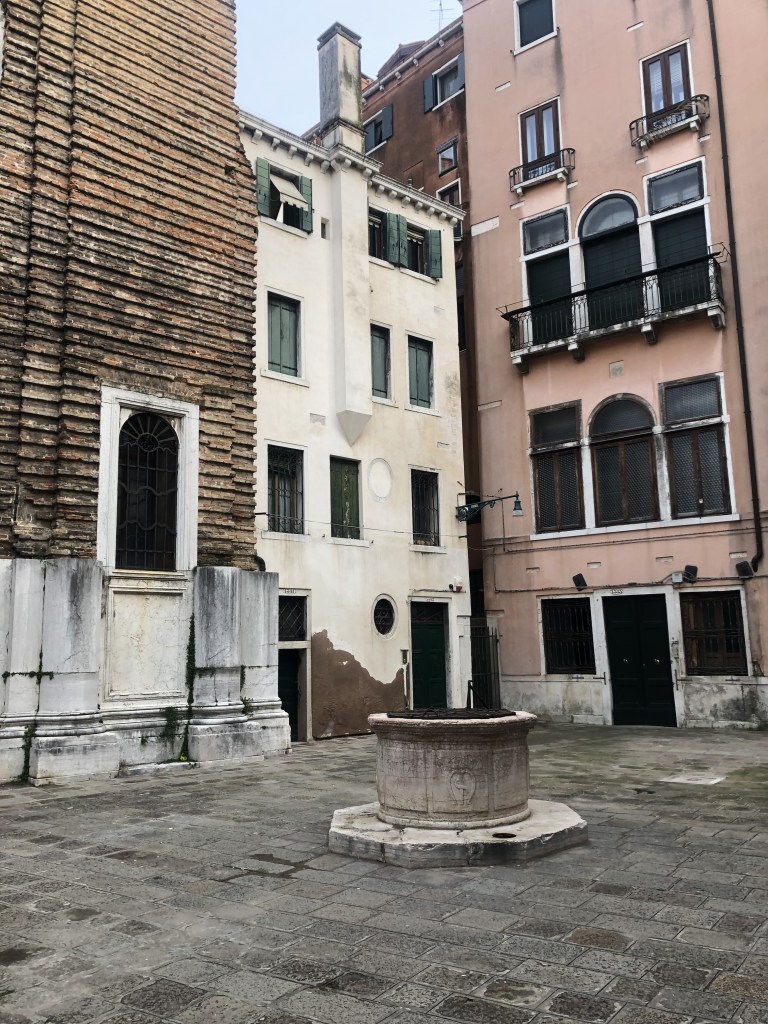
A cluster of large inns or osterie was located in the city’s central areas, near Piazza San Marco and the Rialto commercial district. These catered to a variety of visitors of different means and status. However, numerous Venetian residents also rented out rooms or beds in their houses to foreigners. Many of these hospitality providers were widows like Elena, who made a living, or supplemented their income, in this way, in her case by letting rooms in her house on Campo San Giovanni Novo. Providing room and board was one of the few respectable avenues that allowed these women to support themselves independently.
There were hundreds of these kinds of informal lodging houses (known as albergarie, and later camere locande) spread across the city in the sixteenth century, although many of them could be found in these parishes close to the main port area. In the sixteenth century, the Venetian authorities made greater efforts to register these houses, so that they could collect tax from them but also monitor their foreign tenants more closely.
Although many houses continued to operate illegally, the surviving records give us a fragmentary picture of the diverse landscape of lodging across the city. As well as temporary migrants, lodging houses might provide an important place of first residence for new arrivals before they moved into more settled accommodation. Their operators could thus act as essential mediators between different kinds of migrants, the local community and the Venetian authorities. As they were often migrants themselves, housekeepers might share a language and the experience of travel with their tenants and help them navigate their way in a new city, find work, and build up social networks. Some foreigners made their way to houses run and occupied by their compatriots, where they could speak their own language and eat familiar foods. However, many establishments hosted a diverse clientele who had to find ways to live together in close proximity – sharing meals, and even rooms or beds – despite differences of background and, sometimes, religious belief.
Rosa Salzberg
Further reading
Salzberg, Rosa. “Mobility, cohabitation and cultural exchange in the lodging houses of early modern Venice,” Urban History, 46, 3 (2019): 398-418.
Costantini, Massimo. “Le strutture dell’ospitalità,” in Alberto Tenenti and Ugo Tucci (eds.), Storia di Venezia, V. Il Rinascimento: Società ed economica, Rome: Istituto della enciclopedia italiana, 1996, pp. 881-911.
 HistoryCity Apps