
Architecture of fascism
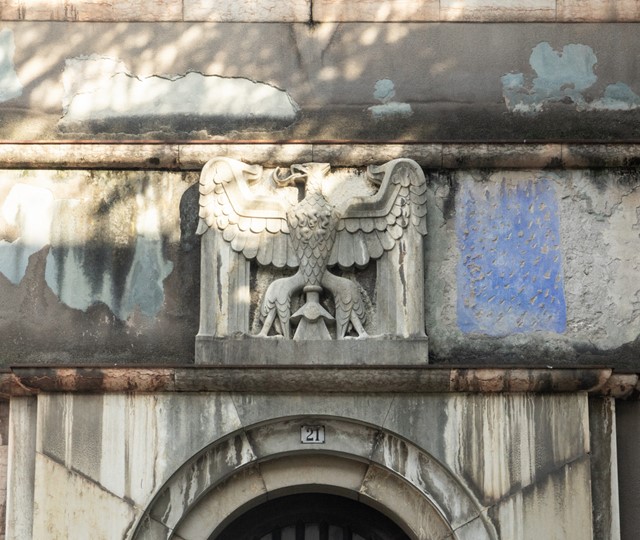
In 1929, the celebrations for the tenth anniversary of the victory in the First World War ended. Urgent postwar reconstruction works were complete and the new structures for the government of the community and the city were in place. In response to the economic crisis and its international context, Mussolini, confirmed as leader of the country in March by the plebiscitary election of the members of the Chamber of Deputies (selected by the fascist party), began major public works. The state and the municipality of Trento, supporting the projects, had a dual objective: to promote the local economy and to define, through architecture and urban design, the image of a modern and “italianissima” city.
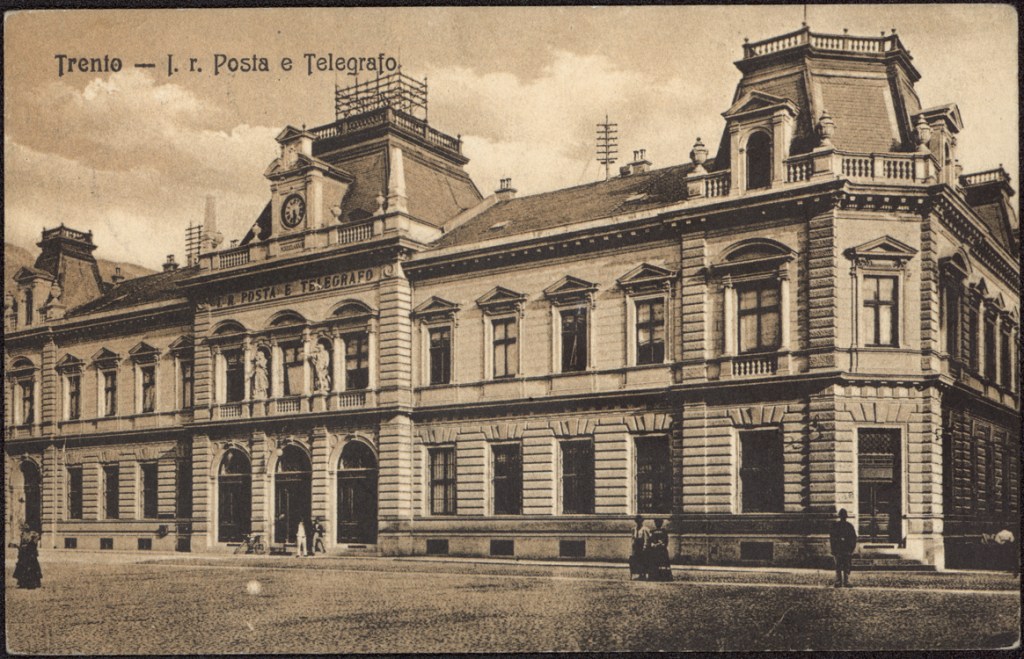
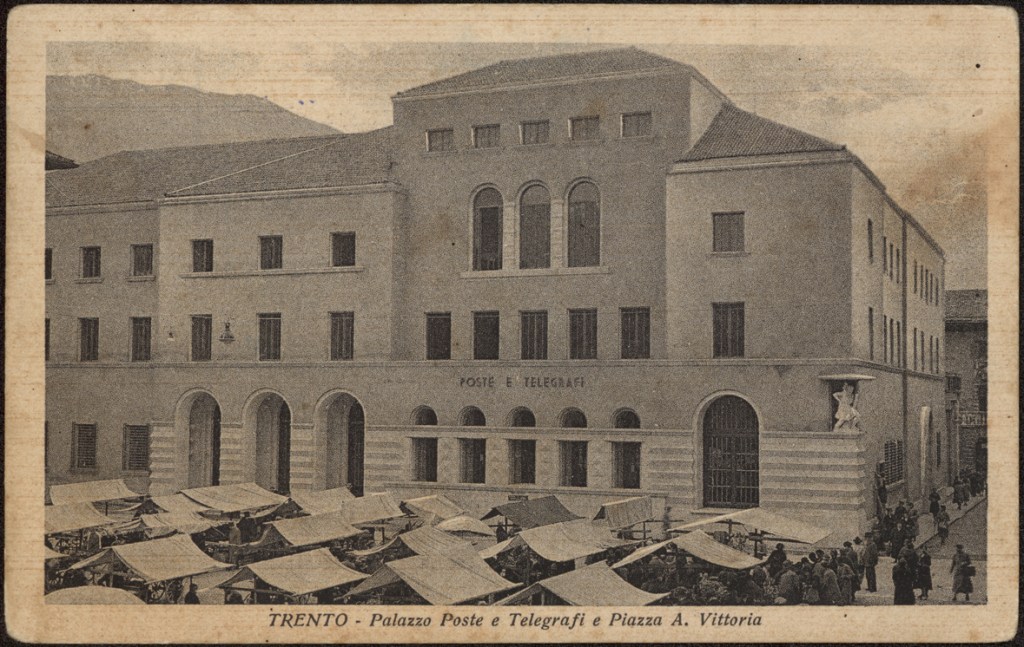
In particular, the construction site of the Post Office marked the beginning of an intense season of public works. This building, and the new railway station, both designed by Angiolo Mazzoni, an official of the Ministry of Communications, started, respectively, in 1929 and 1933. Promoted by the state, they used local materials, such as “Trentino stone” in order to provide work for the artisans and businesses of Trentino. Leafing through the accounts of these construction sites, one finds mention of: Fratelli Redi for the supply of stone and marble from the quarries of Pila, Pinè, Predazzo and Solteri; Fratelli Nones and the Bonvecchio carpentry for windows and furnishings – all companies from Trento – and Komarek of Rovereto for the roller shutters.
The space in front of the Buonconsiglio Castle and the entry to the village of San Martino were redefined with the construction of the modern Raffaello Sanzio elementary school, designed by Adalberto Libera in 1931. In 1933 the monastery of San Lorenzo, which occupied the site of the current bus station, was replaced by the Casa del Balilla, built by Emilio Gaffuri and Guido Segalla. The same designers were simultaneously involved in the implementation of the demolition of the ancient Sas neighborhood, gutted to open the new Piazza del Littorio in the heart of the city.
Public interventions were accompanied by numerous private initiatives. To get an idea of this “construction site city” of 60,000 inhabitants, consider that between the 1930s and 1945, Giovanni Lorenzi – author of the new Casa Littoria – signed off on roughly 50 projects for Trento alone. Together with Segalla and Paolo Albertini, in 1938 Lorenzi also won the competition for the master plan that was to programmatically define the new layout of the city in line with the transformations desired by the fascist government.
Fabio Campolongo
Further reading:
M. Martignoni, Architetture di Trento. 1900-1940, Arca, Trento 1990
F. Campolongo, M. Martignoni, P. Pettenella, C. Volpi (edd.), Giovanni Lorenzi ingegnere (1901-1962), Quaderni di architettura, Mart, Trento 2019
 HistoryCity Apps