
Victory arch
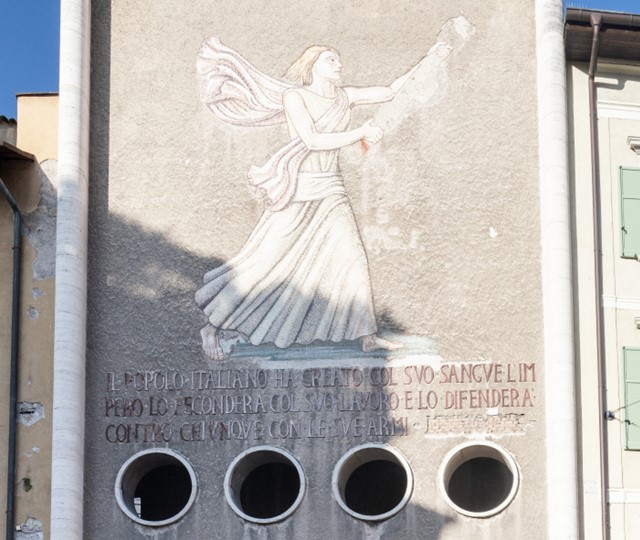
In front of the façade of the church of San Pietro, built 1848-50 based on a design by Pietro Estense Selvatico to complete the historic church of the German district, stands the monumental entrance to the former Piazza del Littorio (now Piazza Cesare Battisti). The stone frame that frames the Allegory of Victory transforms the passage that was opened with the demolition of the ancient neighborhood into a Fascist triumphal arch.
On the façade, left in rough plaster, stands the figure of a woman with a proud, masculine face, who marches while cleaving a fasces. The work, created with an ancient mosaic technique, to resist damage over time, is the result of a national competition won by Gino Pancheri, reserved for artists registered with the Fascist Union. As requested by the announcement, the work celebrates the foundation of the empire, recalled in a didactic, unequivocal and peremptory way by the transcription of the words proclaimed by the Duce, Benito Mussolini, on 9 May 1936 on the occasion of the conquest of Addis Ababa and the foundation of the empire: “The Italian people created the empire with their blood, they will fertilize it with their work and will defend it against anyone with their weapons”.
Just eight months after that proclamation, Mussolini’s words were transcribed in a work that architecturally welds fascism to the eternal glory of the Roman empire, signalled by the four dark oculi that overlook the entrance and recalling, though its architectural forms, the famous tomb of the baker in Rome.
The mosaic work, executed by the Venetian Goffredo Gregorini, is now without the fasces, an Mussolini’s name has been removed from the writing. An abrasion of the plaster, still visible today, also testifies to the elimination of the symbol of the Italian Communist Party, probably painted on the occasion of the removal of the fascist symbols. A photograph, probably dated 1945, also testifies to the affixing, on the clothes of the Victory, of a banner praising the Socialist Party, in whose ranks the engineer Giovanni Lorenzi, appointed Councilor for Public Works of the Municipality of Trento during the years of reconstruction.
The large mosaic is placed on an ephemeral façade; it hides the atrium that illuminates the neighboring houses and, through a covering in glass block tiles, the underlying public passage.

At the entrance to the square, in correspondence with the two commercial porticos, there are still two graffito works by Luigi Bonazza, depicting the Allegory of Work. This detailed representation of Trentino trades and the industriousness of its people is the result of a competition reserved for local artists, announced at the same time as the one won by Pancheri.
Fabio Campolongo
Bibliografia:
E. Tonezzer (ed.), Vuoto di memoria. La riscoperta del quartiere del Sas di Trento, Fondazione Museo Storico del Trentino, Trento 2012
M. Ferrari, S. Retrosi, Gino Pancheri, le opere pubbliche. La donna del Fascio della Galleria dei Legionari, in E. Chini (ed.), Trento Libera. Adalberto Libera e Gino Pancheri nella Trento del Novecento. Guida ai Beni aperti a cura della Delegazione di Trento, FAI (Fondo Ambiente Italiano), Regione Autonoma Trentino-Alto Adige, Trento 2019, pp. 36-39
 HistoryCity Apps