
Carnival and masking

By the eighteenth century, Carnival was an enormous event, and a huge draw for tourists. Though the main (and official) events happened shortly before the start of Lent, Venetian Carnival season had its unofficial start on 26 December, when the theatres reopened after the Christmas closure. Over the next two months or so, other events happened sporadically, most famously the bull hunts. These happened in campi and other open spaces throughout the city, including that of San Polo, and they could be enormous. One hunt in 1708 involved 150 bulls, another in 1739 involved 130 bulls and 200 dogs. These were brutal, bloody affairs, which resulted in certain death for the bulls and often high casualties among the dogs as well.
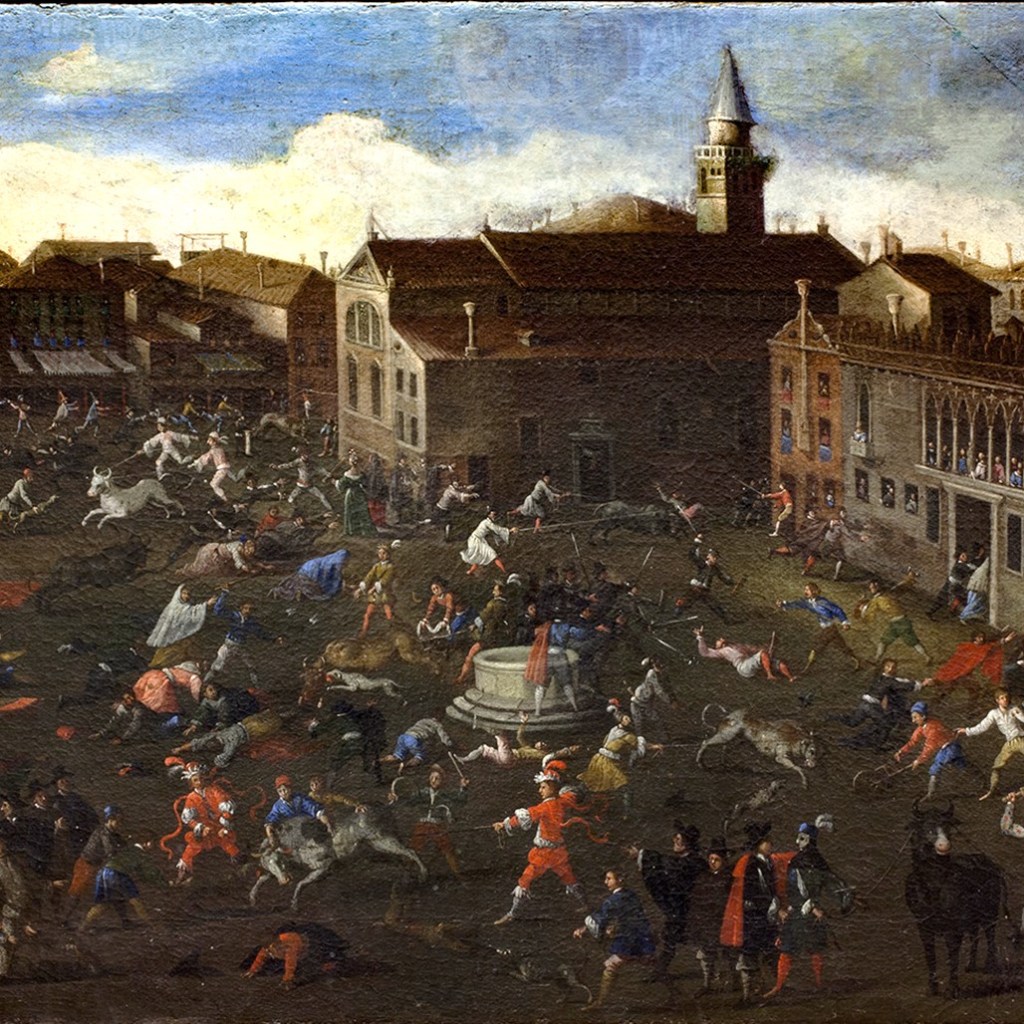
The official city celebration began on Giovedì Grasso (Fat Thursday) and ended on Shrove Tuesday. Thursday’s events involved a procession of government officials who marched out on to the balcony of the ducal palace, from which they watched the festivities in Piazza San Marco. Down on the square, the people were entertained by a range of spectacles: acrobats, sword dancers, the siege and destruction of wooden castles, and more bull hunts. The festivities concluded on Tuesday with public dancing, concentrated in Piazza San Marco and on the Zattere.
Today we associate masking with Carnival. Masking was a part of Carnival, but it was not limited to the Carnival period, and it wasn’t used to provide cover for nefarious deeds. By the late 17th century, masking was common practice for many Venetians from early autumn through to Lent, six months of the year. Masks were also brought out for certain political occasions, such as the election of a new doge, or the election of the very powerful Procurators of San Marco.
Masks were more common in some settings than others; almost everyone (except the dealers) at the casini or the Ridotto (the official casino) wore masks, and so did attendees to the theatre. By the 18th century, in fact, Venetian women were required to mask at the theatre, whether they wanted to or not. Sex workers were required to mask from the 1730s when out in public. Masking was banned, however, in church, and was considered a serious offence. Nobles who entered a convent visiting area or a church masked were threatened with two years’ exclusion from the Great Council (i.e. suspension from government), while anyone else faced a potential four years in prison or 18 months’ service on a galley ship, with their legs in chains.
This demonstrates some of the ambiguity around masking. Overall, masking was often seen as a way to preserve modesty and a certain pretence of anonymity, which allowed for the mixing of classes and sexes with some propriety maintained. Yet masking in a sacred space could demonstrate nefarious plans.
Further Reading:
Bertelli, Stefania. Il carnevale di Venezia nel Settecento. Milan: Jouvence, 1992.
Johnson, James H. Venice Incognito: Masks in the Serene Republic. University of California Press, 2011.
 HistoryCity Apps