
Sex work in the port district
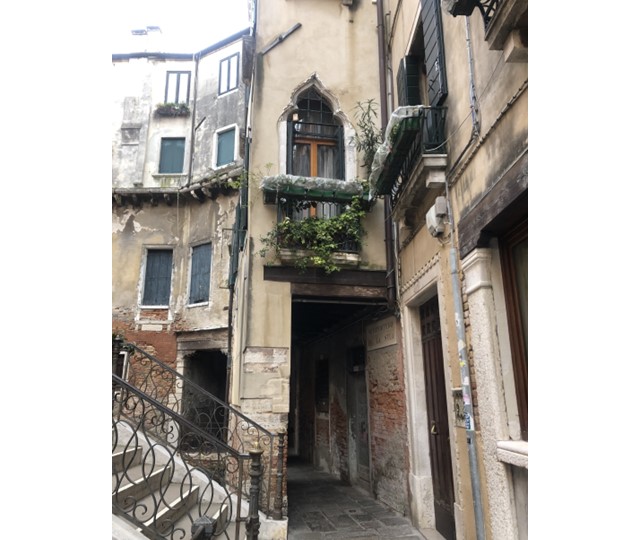
As a port city, Venice also had a flourishing sex industry, which intersected at various points with the hospitality trade. Prostitution was viewed as an ‘essential service’, especially for sailors and merchants visiting the city, but there were efforts to keep it contained to certain zones. Following the Black Death of the fourteenth century, when trade was temporarily crippled, the Venetian government decreed it “necessary because of the multitude of people entering and leaving our city to find a suitable location in Venice as a dwelling-place for prostitutes”. They thus ordained a designated brothel district close to the Rialto market area, called the Castelletto, where all sex workers were meant to live.
By Elena’s time, however, these women had spread out to numerous urban areas, as suggested by a mid-sixteenth century pamphlet called the Tariffa delle puttane (Tariff of Whores) which listed dozens of Venetian sex workers along with their location and asking price. There was a particularly dense clustering in the Castello neighbourhood, presumably because of its proximity to the port, as well as several bathhouses (stue in Venetian dialect) – nominally places for bathing and personal hygiene, but frequently associated with prostitution.
While Venice was also famous for its high-class courtesans, some of whom were accomplished poets or musicians, most sex workers were poor. Many of them were migrants who arrived in the city with few other options to make a living; some were even trafficked there. These women might seek their clients in the central inns, but some also rented out rooms to foreigners, especially later in life when they needed to diversify their careers.
The case of one such woman, Paolina Briani, appears in the files of the Venetian Inquisition from the 1580s. After the Inquisition began operating in Venice in the mid sixteenth century, one of its areas of concern was promiscuous relationships between Christians and people of other faiths. This led to several investigations of lodging houses where foreigners and Venetians shared domestic space, leading to various social, religious, and sexual interactions. Paolina’s house was located in this parish and catered mostly to Ottoman Muslim merchants visiting Venice. She was investigated by the Inquisition because of allegations of religious and sexual promiscuity under her roof. Neighbours and acquaintances of Paolina’s were called in to give testimony before the Inquisition, which met twice a week in the chapel of San Teodoro, behind the Basilica of San Marco, only a few minutes’ walk from here. This case and others like it give us insight into the multicultural encounters that could take place in such houses, and at the same time how they were connected into broader social networks within their neighbourhoods.
Rosa Salzberg
Further reading
Saundra Weddle, “Mobility and Prostitution in Early Modern Venice”, Early Modern Women: An Interdisciplinary Journal 14, 1 (2019): 95-108.
Paula C Clarke, “The Business of Prostitution in Early Renaissance Venice”, Renaissance Quarterly 68, 2 (2015): 419–64.
Ortega, Stephen. Negotiating Transcultural Relations in the Early Modern Mediterranean: Ottoman-Venetian Encounters, Surrey, UK: Ashgate, 2014.
 HistoryCity Apps