
Sex work and the state
From the fourteenth century, the government of Venice legalised sex work, with some limitations. Sex work of course long predated these policies; the legalisation was in recognition of the fact that sex work was happening regardless, and that government control of it was beneficial in multiple ways. The aim was for the state to earn a profit, to keep sex work cordoned off in a particular zone to both control potential disorder and allow ‘honest people’ to avoid it, to prevent worse moral wrongs (such as rape and homosexual sex), and to provide some protection to the women working in this industry.
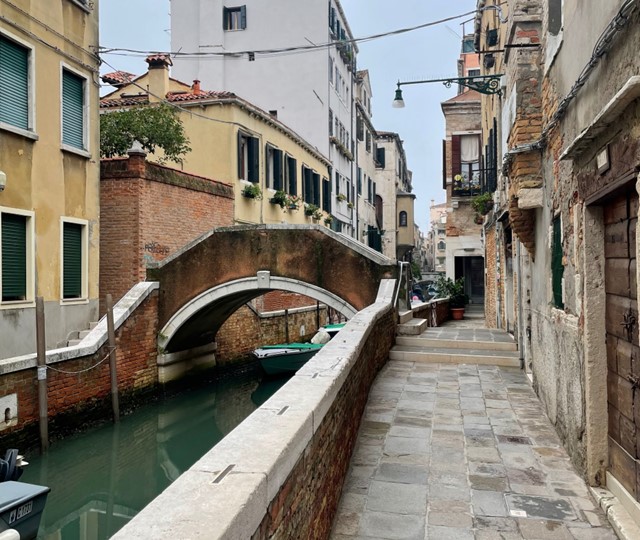
In order to achieve these aims, the state in the early Renaissance designated a particular zone near Rialto market as the only legal location for sex work, and set up state-run brothels in that area. This area was chosen because it was conveniently close to the marketplace of the Rialto, where many clients, foreign and local, could be found, but was not so central as to be easily stumbled upon. The original legal zone is not known for certain, but was most likely in San Matteo parish, to the west of the Rialto bridge. Within a century, however, the government had relaxed its restrictions somewhat, and allowed for houses in the parish of San Cassiano owned by the Rampani family to be rented out as sites of brothels. Soon the legal sex trade was concentrated here, in the area known as the Stue, and which had the (in)famous Ponte delle Tette (pictured above), where sex workers bared their breasts to attract clients.
By the seventeenth century, regulations were relaxed further, and now sex workers could live nearly anywhere they liked; they were restricted only from living on the Grand Canal or in houses that rented for more than one hundred ducats per year (which would have been a very nice and large home). Individual sex workers could also work independently, but the law banning all brothels except those owned by the state remained in force.
Although the state’s main concern was control and profit, some of the rules also demonstrate at least limited concern for the safety and welfare of sex workers. Pimping was strictly outlawed (and severely punished), and within state-run brothels, women were favoured for managerial roles. Female brothel managers could of course also exploit and mistreat sex workers, but there are far more cases of alleged abuse carried out by male ruffians, as pimps were called. By the mid-eighteenth century, when sex work was far more diffuse across the city, we see an interesting new law targeting exploitative landlords, who were sub-letting houses to sex workers at exorbitant daily rents, and also overcharging for things like furnishings, clothing, and linens. One violator of this law in 1749 was banished for an astonishing 20 years from Venice and all its dominions.
Celeste McNamara
Further Reading:
Clarke, Paula C. “The Business of Prostitution in Early Renaissance Venice.” Renaissance Quarterly 68, no. 2 (2015): 419–64.
Scarabello, Giovanni. Meretrices: storia della prostituzione a Venezia tra il 13. e il 18. secolo. Venice: Supernova, 2006.
Weddle, Saundra. “Mobility and Prostitution in Early Modern Venice.” Early Modern Women 14, no. 1 (2019): 95–108.
 HistoryCity Apps