
Women of the village

In Tesino, predominantly male emigration was underwritten by the women who remained in the valley taking on not only the laborious management of household finances and agricultural and pastoral chores, but also the challenging management of commercial negotiations with printers regarding debts left unsettled by heads of families abroad. During the 18th century, nearly a hundred women were required to act as trustees of properties mortgaged by street vendors. It was they who sought solutions, such as deferred payments or postponements, to avoid the confiscation of family assets.
A key aspect of this economic system was the ability of women to independently own, manage, and pledge assets: an uncommon aspect for the time, especially in areas far from major urban centers. Only in this way could women mortgage certain properties or their dowries, and act as guarantors for loans granted to their husbands or sons, the travelling vendors. When in 1773 the Remondini family ordered the seizure of merchandise sent to Bolzano for Giuseppe d’Avanzo, only his mother was able to resolve the situation, having been called upon by the printers themselves to put up her dowry as collateral.
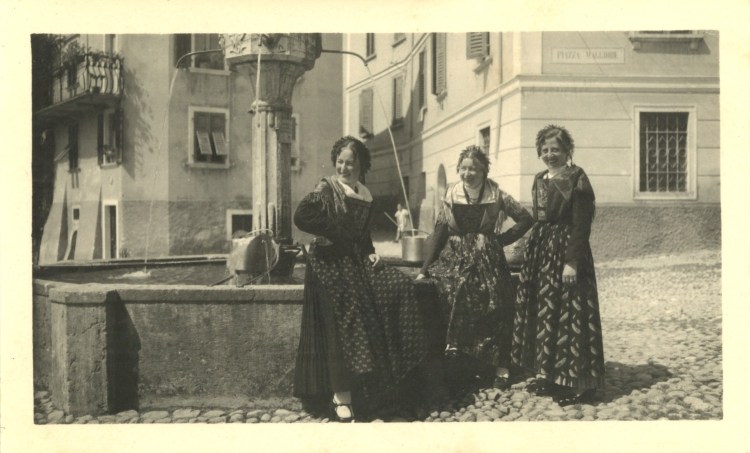
In many cases like this, the Remondini publishers, when signing contracts with travelling salesmen, specifically requested the presence of the women, required to provide guarantees, including their dowries.
Throughout the nineteenth century, there were also women who distinguished themselves through stories that differed somewhat from those centred on the mere subsistence and survival of their families and family assets. One such example was Emilia Fietta Badalai, whose gravestone in the cemetery at Pieve Tesino describes her as a ‘distinguished citizen of Pieve’. Belonging to a family of Tesino merchants active in the 19th century between Strasbourg and Metz, she was part of a story of emigration and social advancement similar to that of many other Tesino entrepreneurs, who were involved in the trade of printed images on a European scale. This chapter of her life, however, ended with the return to their homeland of an entire branch of the family, of which she was the last heir. Having settled back in her native village, where she died in childbirth in 1867 at the age of just twenty-one, Emilia brought with her new tastes and a fresh perspective on women and their social role, acquired whilst abroad. Having grown up in a cosmopolitan environment, Emilia preferred gloves and a small parasol – in keeping with the fashion of the time – to traditional dress. Enterprising and determined, she also loved reading and tastefully furnishing her home, using her wealth to help the unmarried women of the village by providing them with a dowry so they could marry.
Emilia’s story is one of the many family histories that contributed to the social and cultural vitality of the village between the 19th and 20th centuries, highlighting the richness and variety of social and cultural experiences – both male and female – that came to form the great collective epic lived out over the centuries by the inhabitants of Tesino.
References:
Elda Fietta, Emilia Fietta. L’ultima dei Badalai, Museo Per Via, Fondazione Trentina Alcide De Gasperi, 2019
Rosanna Cavallini, Colorare i santi. Le pie immagini dei Remondini nel Settecento, Museo Per Via, Fondazione Trentina Alcide De Gasperi, 2023

