
House of antiquities

The Grimani were one of the most prominent noble families in Venice and this property had been acquired by Antonio Grimani, doge in the 1520s. By Elena’s time it had passed on to Antonio’s nephew, Giovanni Grimani, holder of the highest ecclesiastical position in Venice: the Patriarchate of Aquileia. Although he aspired to become a cardinal, Giovanni Grimani never reached this position because he was suspected of being sympathetic to the Protestant cause, in a period when Rome was becoming increasingly alarmed about the growing schism in the Catholic church.
Giovanni Grimani oversaw the renovation and decoration of his palazzo in the latest Renaissance style. He called leading artists to Venice, especially from Rome, such as Federico Zuccari and Francesco Salviati, to produce magnificent frescoes and stuccoes including numerous mythological scenes and classical-style grotesques. The palazzo was redesigned around a central courtyard, in the style of an ancient Roman noble house.
Like other Venetian patricians at this time, Giovanni Grimani collected antiquities: Greek and Roman sculptures, marbles, bronzes, medals. The art historian Patricia Fortini Brown describes this palazzo as “the first attempt by Venetian patrons to provide a proper all’antica – that is ancient Roman – setting in which to display classical objects,” showing off prized possessions to best effect. Grimani himself probably designed a gallery inside called the Tribuna for his most precious antiquities, inspired by the Pantheon in Rome and illuminated from above, which quickly became a must-see for eminent visitors to Venice in this period.
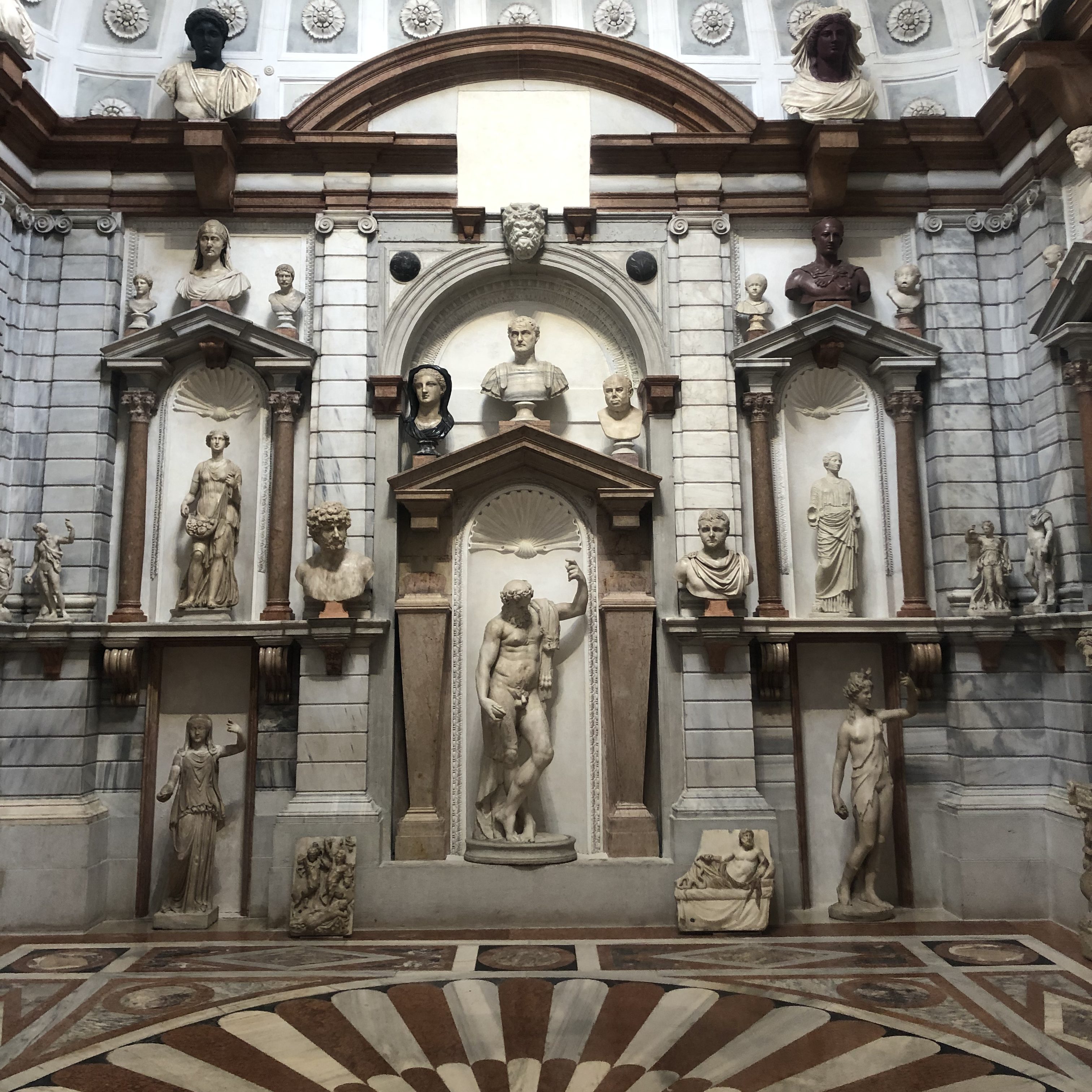
Other pieces were displayed around the loggias and the central courtyard. The doorway clearly proclaims the neo-classical pretensions of the owner, with Corinthian columns, Roman portrait busts and a dedication of the palace “To the glory of the city and for the use of friends” (GENIO/ VURBIS/ AVG(usto)/ VSVIQ(ue)/ AMICO/RUM). And indeed, upon his death in 1593, Grimani left much of his collection as a gift to the Republic of Venice. Many of the best pieces were then moved to the antechamber of the Marciana Library in Piazza San Marco to form the basis of one of Europe’s first public museums.
Although the nearby Campo Santa Maria Formosa hosted some other magnificent noble palaces, the street that this alley runs off, the Ruga Giuffa, was less prestigious. It was a notorious locus of sex work in the sixteenth century. There are various theories about where the name of this street comes from, but one suggests that it testifies to the presence of Armenian merchants from the city of Julfa, now in Azerbaijan, in this area.
Palazzo Grimani is now a museum and well worth a visit.
Rosa Salzberg
Further reading
Patricia Fortini Brown, Private Lives in Renaissance Venice. Art, Architecture and the Family, New Haven & London, 2004, pp. 229-35.
Annalisa Bristot, ed. Palazzo Grimani a Santa Maria Formosa. Storia, arte, restauri. Verona: Scripta, 2008.
 HistoryCity Apps