
Fascism’s public liturgy
The fascist regime invested heavily in the propaganda value of collective rituals. In addition to celebrating the power of fascist Italy, military parades and public ceremonies served to legitimize Mussolini’s government and consolidate consensus around the leader. The complex set of rituals and symbolic practices constructed by the regime to celebrate itself gave rise to a true state liturgy, an expression of a civil religion founded on the cult of Mussolini’s personality.
Designed to evoke collective emotions and strengthen the sense of national identity among citizens, fascist rituals were the object of significant investment. To create a symbolic and ritual storehouse, fascism drew on various historical and cultural references, mixing the memory of wartime daring with the myth of Rome, combining the ideas of Gabriele D’Annunzio and the avant-garde with military symbolism.
Alongside the fascistization of existing holidays (such as November 4, the date of victory in the First World War), the Mussolini government promoted new ones, using commemorations as tools to consolidate the regime. The workers’ holiday on May 1 was abolished and absorbed into the celebration of the Birth of Rome (April 21); that of September 20 in memory of the Unification of Italy was abandoned in 1930. National holidays became the anniversaries of the March on Rome (October 28), the foundation of the Fasci di Combattimento (March 23) and that of the Lateran Pacts (February 11). Several religious holidays were the subject of a fascist re-signification: December 24 became the Day of the Mother and Child, the Epiphany was transformed in 1928 into the fascist Befana, a holiday that involved a large distribution of gifts to children and the poorest families. As the party grew in size, controlling and incorporating ever larger portions of society, the audience for fascist demonstrations grew to include large masses of citizens. The rallies of the 1930s, aimed at displaying the strength of the regime, involved crowds throughout the country.
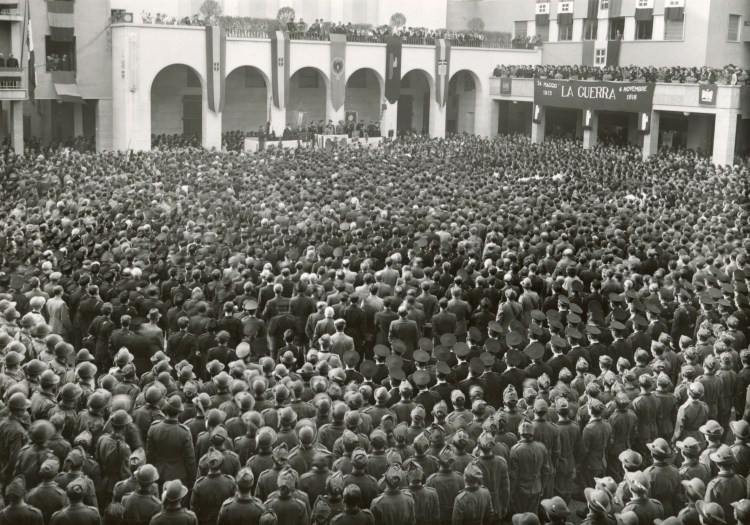
Mussolini himself played a central role in the fascist liturgy. The Duce’s travels throughout Italy were marked by solemn ceremonies, with parades and street demonstrations that called the citizens to rally. The Roman rallies in Piazza Venezia, which culminated in Mussolini’s speeches on the balcony, were attended by tens of thousands of people. In many cases, they were broadcast by radio and played in squares across the country, allowing Italian citizens to participate in the same collective rite and celebrate their loyalty to the regime.
Maurizio Cau
Bibliografia:
S. Cavazza, Piccole patrie. Feste popolari tra regione e nazione durante il fascismo, Bologna, il Mulino, 2003
E. Gentile, Il culto del littorio. La sacralizzazione della politica nell’Italia fascista, Roma-Bari, Laterza, 2001
 HistoryCity Apps