
At the table of the nobility
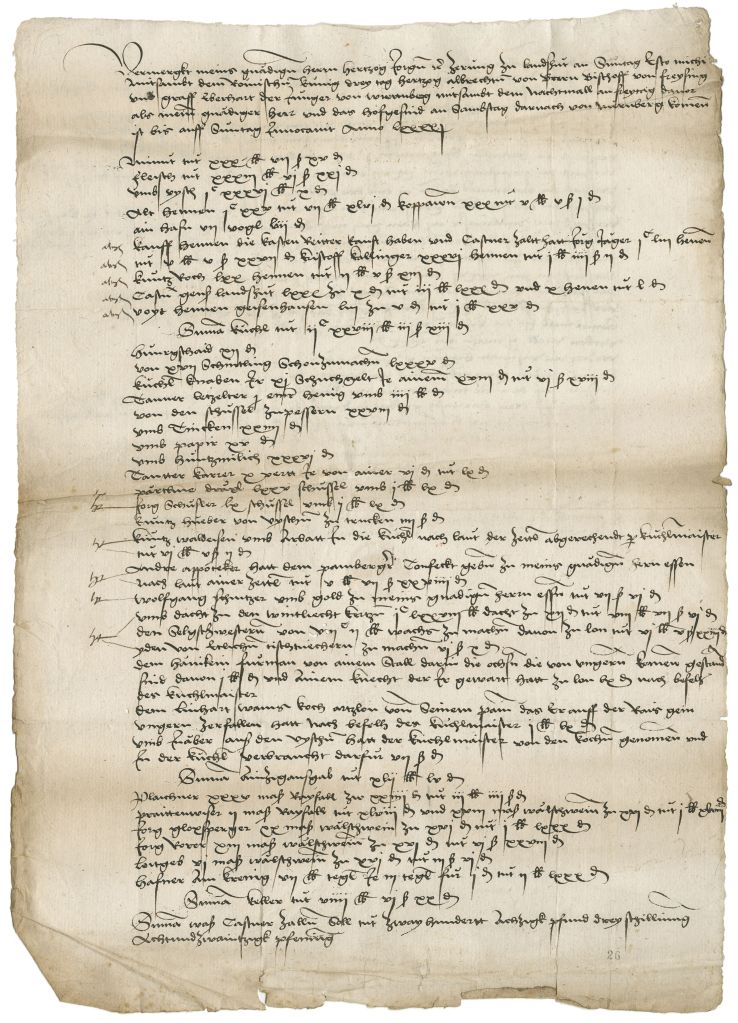
The Landshut ducal court secured an undeniable place in posterity with its extremely lavish festivities. The rich Landshut dukes Ludwig and George appeared at this time not only in Bavaria but also in the empire as the representatives of the House of Wittelsbach.
At the time of the rich dukes, the reigning duke resided in Landshut, while Burghausen had advanced to a secondary residence, where the duchess and the children lived. The latest source research gives an idea of the dimensions of the Landshut court, which cannot be grasped in exact figures due to the poor state of records and the different accounting offices at the court for the payment of salaries. That more than 200 people were in the service of Ludwig the Rich at his Landshut residence can be ascertained from two different types of sources. In 1460, 61 court servants were paid by the court chamberlain, and an average of about 140 persons were paid by the chamberlain in the accounting years 1474/75 and 1477/78. These figures increased somewhat under his son George.
The dining habits of Dukes Ludwig and Georg were luxurious and extremely costly. Comparisons of the total expenditure of 18,451 pounds pfennigs for meals in the accounting year 1491/92 under Duke Georg with other German courts show that the Landshut court clearly surpassed other high-ranking German courts in terms of of table luxury: 3.5 times the annual sum spent to maintain the Munich court in 1464, namely 2,800 pounds pfennigs, was spent in Landshut in 1491/92. At the court of Elector Albrecht Achilles of Brandenburg, 9,318 pounds pfennigs was the guideline spend for the kitchen, cellar, chamber and stables: half as much as in Landshut!
In the Middle Ages, food reflected a person’s social rank. In addition to at least three snacks in between, there were two main meals in the morning and evening for the upper class, which could be very lengthy. The seating arrangement at the table and the quantity and quality of the food served ranked each feast. This is impressively illustrated by the court order issued by Duke George in 1491 for the court servants at Landshut Castle, in which this was precisely specified.
This court order was also intended to reduce the enormous costs of maintaining the court and to encourage the servants to be thrifty. Spices, for example, which had to be imported at great expense, were reserved for rich households. Only the head cook at the court of George the Rich had a key to the spice chest and he supervised the use of these luxury goods, as can be read in the court order of 1491. Expensive spices lent special luxury to the food, as did the use of color and gold to decorate the dishes. At the Landshut wedding, 207 pounds of saffron alone were consumed, one of the most expensive spices of all at this time.
Irmgard Lackner
Further reading:
Biersack, Irmgard, Die Hofhaltung der „reichen Herzöge“ von Bayern-Landshut (=Regensburger Beiträge zur Regionalgeschichte 2), Regensburg 2006.
 HistoryCity Apps