
Mendicant friars and the theology of work
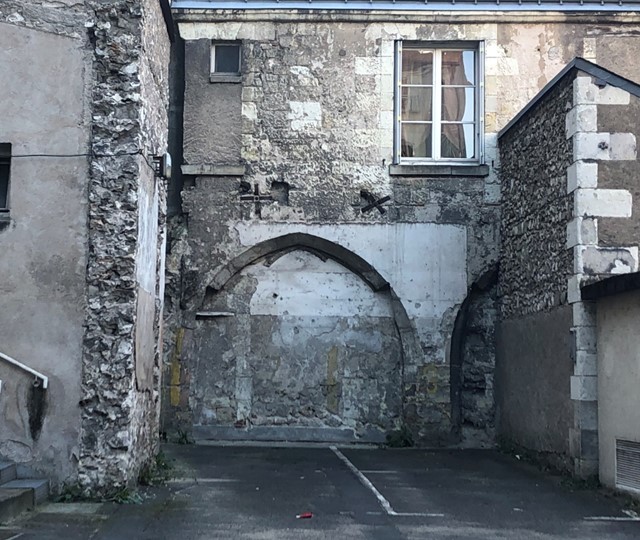
The convent of the Franciscans in Tours was part of the urban landscape since 1224, financed by donations from the lay urban population. Franciscan friars regularly received donations and payments from the city council for the sermons they preached in streets and on crossroads throughout the city during Lent.
The Minim Friars founded by St Francis of Paola are a branch of the Franciscan order. Medieval Franciscans sought to improve the religious education of the urban population and, for the friars themselves, adopting the poverty of Christ was one of their most important duties.
No female religious communities were founded within the city walls of Tours. The Third Order of Saint Francis, however, offered possibilities for urban lay women to live a religious life without professing the vows of a nun. For example, the saint-like laywoman Jeanne-Marie de Maillé (1331-1414) lived a life of charitable works among the poor and sick in Tours. It is likely that her example was followed by other women from Tours, such as the lay woman Perrine Gourdonne who stated in her will from 1502 that she was a sister of the Third Order of Saint Francis. The central place of simplicity and Evangelical poverty in the Franciscan interpretation of the Gospels gave rise to a theological re-evaluation of manual labour.
Both lay people and clergy were encouraged to occupy themselves with manual labour as the basis for their spiritual life. A good example of this new theology of manual work is the painting of an artisan family attributed to the famous manuscript painter Jean Bourdichon from Tours. In the accompanying poem the artisan states that he is better off than rich people and ethically superior to them: “I work in order to stay out of poverty/ My wife spins and so God provides us with what we need/ In this manner we live without faithlessness/ Nothing is better than the middle way” (Je travaille fuyant necessite/ Ma femme fille aincy dieu nous pourvoye/ Par se moyen vivons sans faucete/ Il nest cy bon que la moyenne voye, Paris, BnF, MS 2374, f. 1v-2v). The fact that Bourdichon depicted a carpenter and his family resonates strongly with the Holy Family and Joseph’s work as a carpenter.
The carpenter
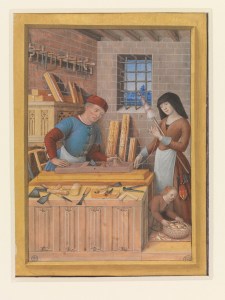
The image of the Jehane, the guide for the Hidden Tours app trail ‘The Passion Quest’, was taken from this small painting attributed to the famous manuscript painter Jean Bourdichon from Tours. The accompanying poem in French expresses the growing social and religious self-awareness of late-medieval artisans. Bourdichon’s depiction of this artisan woman was probably based on his own experiences of urban society in Tours. It is very likely that Jehane Bernarde dressed similarly to this artisan woman: the inventory of her possessions mentions four brown dresses. This image comes from a series called the four estates of society: here, the artisan (ca. 1505-10).
Following Christ
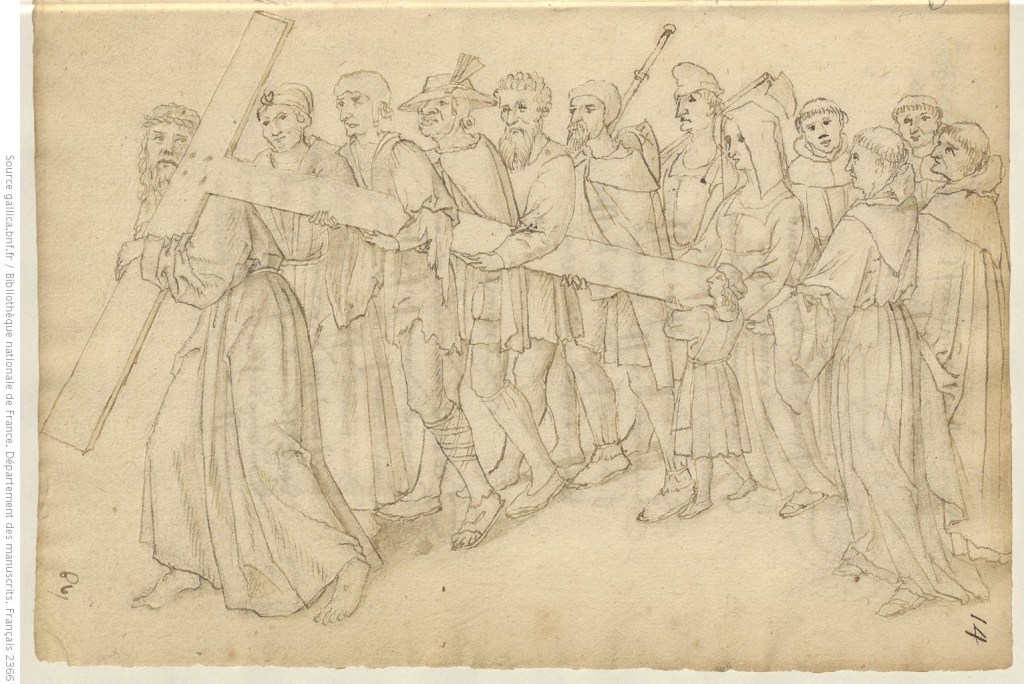
This drawing and its accompanying poem refer to Christ’s words “If anyone would come after me, let him deny himself and take up his cross and follow me” (Matthew 16, 24). It is part of a small booklet from the royal collection with poetry and drawings very close to Jean Bourdichon’s work. The people depicted in the drawing are all poor and are bearing their personal cross. The group includes four Franciscan friars. In the poem, the labourer compares his heavy workload to Christ’s suffering while carrying the cross, thus stressing the spiritual value of manual labour.
Margriet Hoogvliet
Further reading:
Claire Mabire La Caille, “Evolution des enclos conventuels des mendiants à Tours (XIIIe-XVIIIe s.)”, Supplément à la Revue archéologique du centre de la France 1 (1981), pp. 13-72
Benoist Pierre, André Vauchez, eds., Saint François de Paule et les Minimes en France de la fin du XVe au XVIIIe siècle, Tours, Presses Universitaires François-Rabelais, 2020, pp. 181-198.
Margriet Hoogvliet, “Manual Labour and Biblical Reading in Late Medieval France”, Journal of Early Modern Christianity 6/2 (2019), pp. 277–297.
 HistoryCity Apps