
Women, washing and gossip
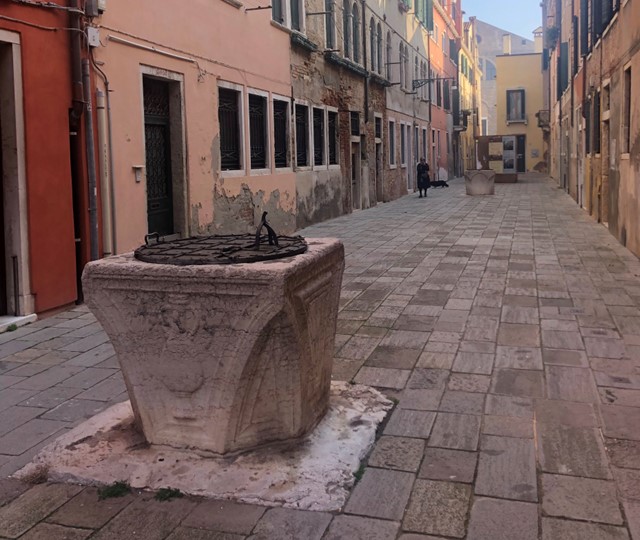
Venice’s numerous wells were essential to provisioning this city on the sea with fresh water. Instead of tapping into groundwater, these were actually cisterns that collected, filtered, and stored rainwater. While noble families had their own private cisterns, public ones like the two in this street were used by the less well-off for their drinking, hygiene, and washing needs. They were opened for use twice a day by the capi di contrada, or neighbourhood captains. However, as the city’s population expanded, and during periods of drought, water sellers or acquaroli frequently had to bring in fresh water from the mainland, which they sold around the city. Professions that used a lot of water, including laundresses like Anna in the ‘City of Refuge’ app trail, were not meant to use the public wells. In the sixteenth century, Venetians also began building more houses for ordinary renters with internal cisterns, although public wells retained their importance for many people.
Wells, and neighbourhood streets and squares more generally, continued to serve as crucial spaces of sociability, especially for women who often had responsibility for collecting water, as well as washing and cooking. While lower-class women might range across the city – or even outside of it – to do business, run errands or visit friends or relatives, much of their everyday lives revolved around spaces like this one. As many people did not have much room in their houses, many domestic tasks might take place outside their front doors, providing opportunities also for social encounters with neighbours and passers-by.
The porous nature of Venice’s urban fabric – with noise travelling through windows and doors, down canals and alleyways – also allowed neighbours to keep an eye on each other. While men gossiped just as much as women, female gossip was seen as a powerful force which could make or destroy local reputations, especially those of other women. It is for this reason that courts such as the Inquisition frequently turned to neighbours, including many women, as sources of information about what went on in the city and even in the intimate domestic lives of its inhabitants.
Neighbourhood sociability was also particularly important for recent immigrants settling into life in Venice. Many new arrivals, like Elena in the app trail, chose to live with or near their compatriots or relatives, especially when they first arrived. This helped them overcome the difficulties of adjusting to a new city, learning the language, finding work and solidarity. Most Christian migrants were not forced to live in any particular area, unlike the Jews in the Ghetto and later Muslim merchants in the Fondaco dei Turchi. However, many members of ‘minority’ groups such as the Greeks and the Slavs clustered together in neighbourhoods like this voluntarily, to benefit from proximity of their compatriots.
Rosa Salzberg
Further reading
David Gentilcore. “The cistern-system of early modern Venice: technology, politics and culture in a hydraulic society”, Water History, 13 (2021): 375-406.
Monica Chojnacka. Working Women of Early Modern Venice, Baltimore & London: Johns Hopkins University Press, 2001.
Elizabeth Horodowich. “The Gossiping Tongue: Oral Networks, Public Life and Political Culture in Early Modern Venice”, Renaissance Studies 19, 1 (2005): 22–45.
 HistoryCity Apps