
Council, court and tavern
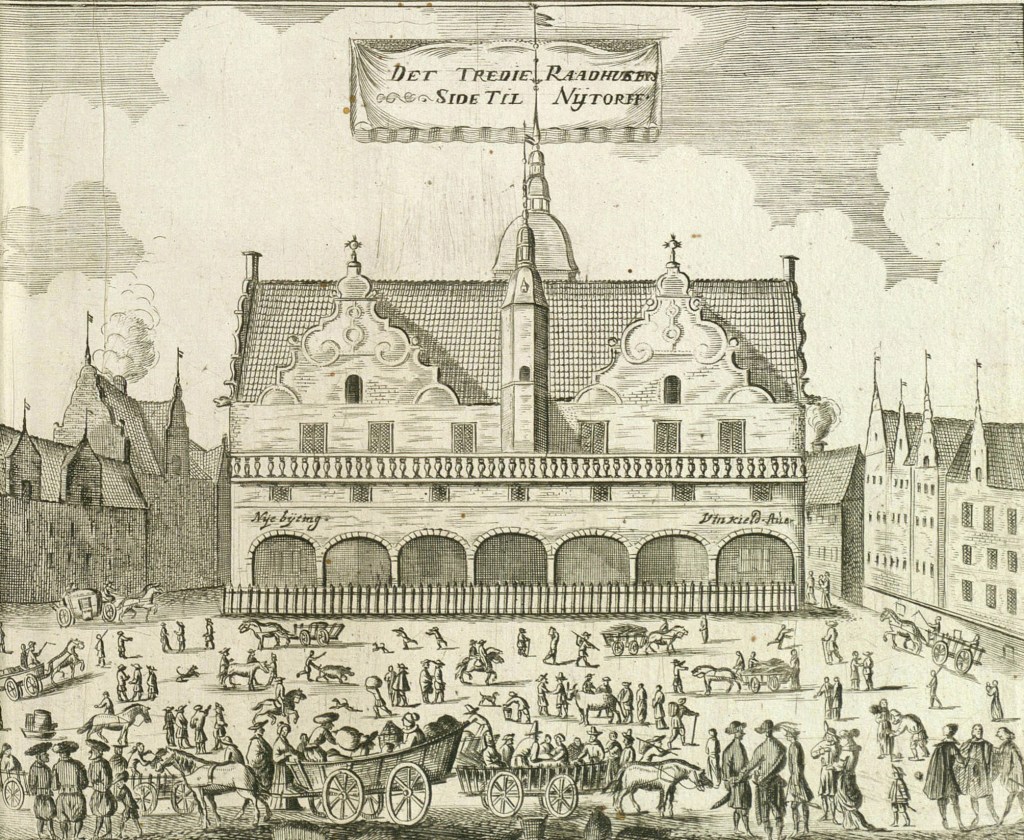
The town hall was located on the southeast side of Gammeltorv (Old Square). It was built in 1479, but in 1608-10 King Christian IV had it renovated in the Dutch Renaissance style with beautifully curved gables and spandrels. On the front side facing Gammeltorv, the town hall had a slender stair tower and at the foot of the tower was a monumental staircase leading up to the main entrance. The rear-side facing Nytorv (New Square) had a smaller octagonal tower and an open archway on the ground floor.
Inside the town hall was the city government. It was split into two separate councils: The Magistrate and the 32 Men. The Magistrate had been in charge of the city’s administration since the Middle Ages. The council was made up of mayors and councilors – typically people from the city’s upper-middle classes and learned official elite – and dealt with many matters concerning the city. For example, the Magistrate had to permit artisans and merchants to settle and work in the town, and they also helped decide when the town gates were opened and closed.
The second council, the 32 Men, consisted of men from the wealthiest part of the bourgeoisie, the city’s merchants. King Frederik III had set up the council during the Swedes’ two-year siege of Copenhagen in 1658-1660. Here, the citizens helped defending the city and had thus helped save the kingdom from destruction. In return for their efforts, the city was granted special privileges, including the 32 Men, who had a special right to plead the citizens’ case to the King.
In the town hall basement, there was a detention where drunkards, beggars, and prisoners in custody were held. In addition to the prison, there was also a tavern in the basement. The penitentiary and the tavern were next door to each other. It was an old tradition to have a tavern in the town hall. As early as 1443, King Christopher of Bavaria decreed that the Magistrate had the right to a tavern in the town hall cellar. However, the tavern was not run by the Magistrate. Instead, the premises were rented out, and the contract with the tavernkeeper Johan Daniel Klein from 1685 states that, like similar town hall cellars abroad, he was to serve “several kinds of both Rhenish, Spanish and French wines as well as all other kinds of wines and all kinds of foreign beer.”
The Bytinget (District Court) was housed in an open archway on the ground floor facing Nytorv. The archway protected the judges and court clerks from rain, snow, and wind while ensuring that court proceedings could take place in public and under the open sky, as was the custom. So everyone could see that justice was done. If one disagreed with one’s verdict at the District Court, one could appeal to the Rådstueretten (the City Hall Court), which was based inside the town hall.
Initially, both the Court and the scaffold had been located on Gammeltorv. But both were moved to Nytorv during the rebuilding. The city’s scaffold and shame pole dominated Nytorv. It was here that offenders were publicly punished by e.g. branding, whipping or decapitation. Public punishments also took place elsewhere in the city or outside the city gates – right next to the western main road – where another scaffold and the great gallows were found. The last execution on the scaffold behind the town hall occurred in 1758.
Peter Wessel Hansen
Further reading
Carl Bruun: Kjøbenhavn, vol I-II, 1887-1890.
Rikke Simonsen: Kongens by. København og historien, vol. 4, 2022.
 HistoryCity Apps