
The public square
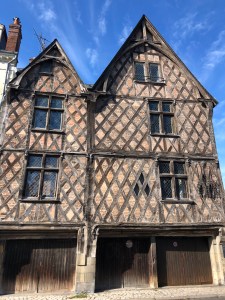
The city of Tours included several public squares surrounded by half-timbered houses with shops and workshops opening to the street. Several of these medieval houses survive in present-day Tours, such as the two fifteenth-century houses on the place Foire-le-Roi that are part of ‘The Passion Quest’ app trail.
The presence of woodlands together with possibilities for transport over water were favourable for the construction of half-timbered houses, notably during the fifteenth century. Some of the half-timbered houses in Tours have elaborate woodwork sculptures skillfully executed with much detail. The spaces on street level were usually open and in use as shops or artisan workshops.
Several public squares are also located in the western urban part of Tours near St Martin’s basilica. In the fifteenth century the river flowed closer to the place Foire-le-Roi than it does today, so this square was directly connected to the river harbour with docking places for ships. Because of its position important annual fairs were held on the place Foire-le-Roi. In 1355, in order to finance the walling of the city, King Charles II granted the city additional market rights: hence its name, “square of the King’s fair”.
The public squares of Tours had many other functions: these were where Friars preached public sermons during Lent; they were part of the itinerary of processions and royal entries; they could be gathering points for the population in times of discontent or upheaval; and they were the venues for theatrical plays.
Tours had a thriving theatre culture in the late Middle Ages. The earliest mention of a theatrical performance dates from 25 July 1390, when the city council payed several men to be on guard on the city walls while a play of the “Seven Virtues and Seven Vices” was performed. In spite of the uncertainties of the Hundred Year’s War the inhabitants in collaboration with the canons succeeded in organising theatrical performances. For example, the place Foire-le-Roy was transformed into a theatrical space with wooden tribunes and stages for a Passion play in 1455.
The rich theatre culture of Tours is also suggested by the presence of over 50 theatrical texts in a late-medieval booklist from Tours, and the printed editions of “The Sinful Man” (c. 1494), which according to the title page was performed in Tours. In this play human virtues and vices are embodied by stage characters, stressing the importance of repentance in order to avoid the punishments of hell.
Learn your lines
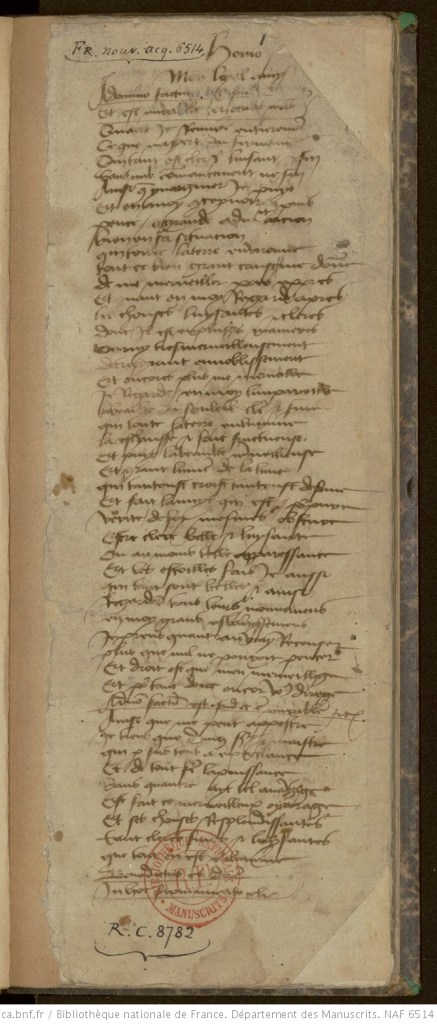
The only surviving textual witnesses of the allegorical theatre play “Sinful man by actors, performed in Tours” are printed editions, such as one made by Antoine Vérard in Paris after 1494. It is a play representing human virtues and vices as stage characters, stressing the importance of repentance in order to avoid the punishments of hell. This handwritten copy on cheap paper only reproduces the verses of the main character “Man” and was used for an actual performance. It was common practice to copy by hand the roles for different characters, so that the actors could memorise their parts.
Margriet Hoogvliet
Further reading:
Bernard Chevalier, Tours, ville royale (1356-1520): origine et développement d’une capitale à la fin du Moyen âge, Leuven, Nauwelaerts, 1975.
Graham A. Runnalls, Les mystères français imprimés: une étude sur les rapports entre le théâtre religieux et l’imprimerie à la fin du Moyen Âge français, suivie d’un Répertoire complet des mystères français imprimés (ouvrages, éditions, exemplaires) 1484-1630, Paris, Champion, 1999.
Clément Alix, Julien Noblet, “Les spécificités des maisons en pans de bois de Tours (seconde moitié du XVe-premier quart du XVIe siècle)”, Béatrice de Chancel-Bardelot, et al., ed., Tours 1500 : capitale des arts, Paris, Somogy-Musée des Beaux-Arts, 2012, pp. 115-117. Charles de Grandmaison, Documents inédits pour servir à l’histoire des arts en Touraine, Paris, J.B. Dumoulin, 1870.
 HistoryCity Apps