
Foundations for the salvation of souls
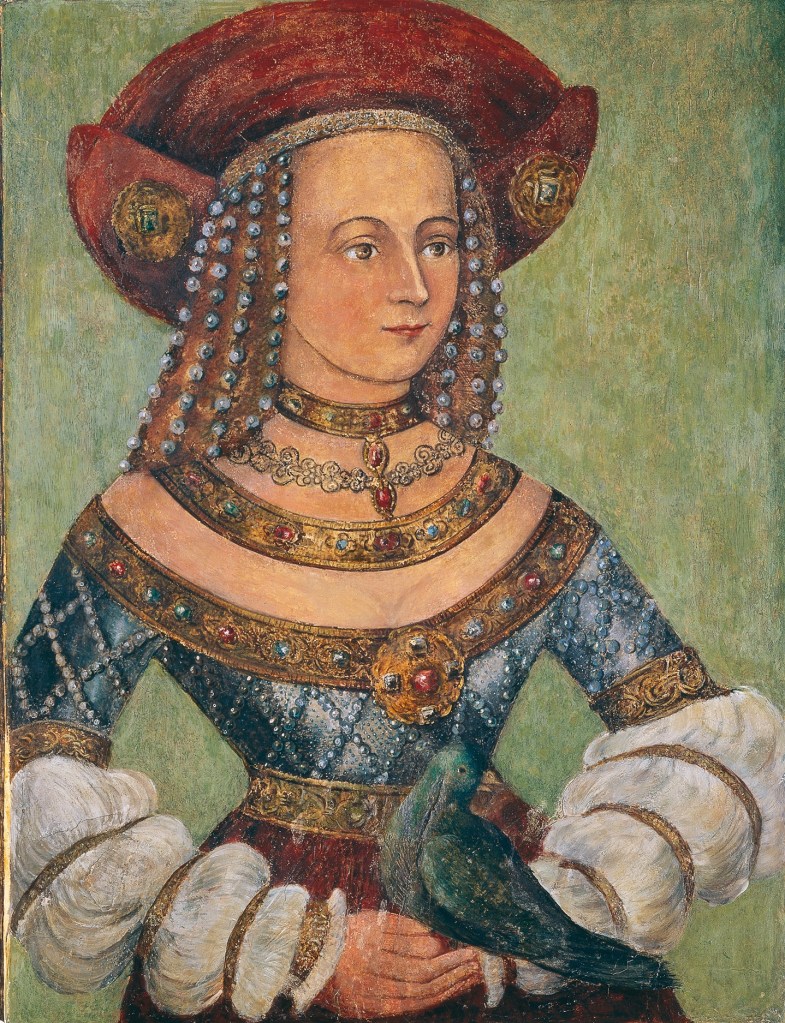
© Bavarian Palace Department Rainer Herrmann/Ulrich Pfeuffer, Munich
In keeping with the spirit of the times, the “rich dukes” were active as benefactors of spiritual and charitable institutions. In 1460, Duke Ludwig the Rich founded the Holy Cross Convent of the Franciscan nuns in the Freyung district of Landshut. In it, women who had previously lived in private houses and held their prayer services there founded a new space with monastic rules. The convent was secularized in 1802. The baroque monastery buildings and the profaned church belong today to the complex of the Hans Carossa Grammar School.
Not only monasteries, but also hospitals were an enormously important building blocks in the social networks of the late Middle Ages. They were the first and in many cases the only place to go for the sick and elderly, as well as being a place for travelers and pilgrims. In Aichach, Braunau, Reichenhall, Dingolfing, Schrobenhausen and Erding, the dukes sponsored the building of hospital churches or the foundation of hospitals for the Holy Spirit.
For many sick people, leprosariums and infirmaries were the last resort. Duke Georg and Duchess Hedwig, for example, supported the construction of the leprosaral church Heiligkreuz in Burghausen, which was built in 1477. In Landshut, the Dutch merchant Walther vom Feld founded the Rochus-Blatternhaus near the Church of the Holy Spirit. Walther was in the service of the Landshut ducal court and had also helped finance the magnificent Landshut wedding feast in 1475.
Many rich citizens of Landshut, as well as members of the court of the “rich dukes”, were active as charitable benefactors. Christoph Dorner, chancellor of Duke Ludwig, set up a foundation for eight poor people one year after the Landshut Wedding. They were provided with a loaf of bread and two pounds of meat every week. Of course, this endowment was not without self-interest: after his death, the poor were to pray daily at Chancellor Dorner’s grave for his salvation and attend mass in the Church of the Holy Spirit.
A very special endowment, directly related to the Landshut wedding feast, was possibly made by the bride Hedwig herself. A votive crown from the first half of the 18th century, which belonged to the furnishings of the Burghausen castle chapel, is kept in the Oberhausmuseum in Passau. It also contains jewelry from the 15th century, as recent research has shown. According to the myth, Duchess Hedwig donated her bridal jewelry to make a votive crown for a Madonna figure in the Burghausen castle chapel.
Irmgard Lackner
Further reading:
SPITZLBERGER, Georg: Das Herzogtum Bayern-Landshut und seine Residenzstadt 1392-1503, Landshut 1993.
STAUBER, Reinhard/TAUSCHE, Gerhard/LOIBL, Richard: Niederbayerns Reiche Herzöge (=Hefte zur Bayerischen Geschichte und Kultur 38), Augsburg 2009.
https://www.idowa.de/inhalt.landshuter-hochzeit-das-raetsel-um-die-brautkrone.1c43be71-6628-4389-ae07-6525e6e77e4d.html (Landshuter Zeitung, Member of the Attenkofer Media Group)
 HistoryCity Apps