
Mansions and book stalls
Towards the end of the seventeenth century a French collector of fifteenth-century royal correspondence pasted a curious document of unknown provenance in his album. It is a list of books with the heading “Books in French in Tours in front of the urban mansion of Monseigneur de Dunois” (Livres en francois a Tours devant l’ostel monseigneur de Dunois).
The nineteenth-century editor of the book list, Achille Chéreau, presented it as the inventory of a bookseller in Tours active in the second half of the fifteenth century, possibly a retail seller for the Paris-based printer Antoine Vérard. The list mentions over 267 books in French, including historical works, literary fiction, religious and Bible-based texts, Books of Hours, and texts of theatre plays, both handwritten and printed. Chéreau concluded that this list represented the stock of a bookseller, but a later historian proposed that it was the inventory of a private library. Meanwhile, the list has been dated variously, even to as late as 1527.
However, a re-evaluation of all the items mentioned in the booklist using more recent databases revealed that no new books were added after 1494, thus suggesting the date of the list. Moreover, several mentions in the list such as “and many others in great quantities” are indications that this list was made by book seller specialising in second-hand books who wanted to attract customers.
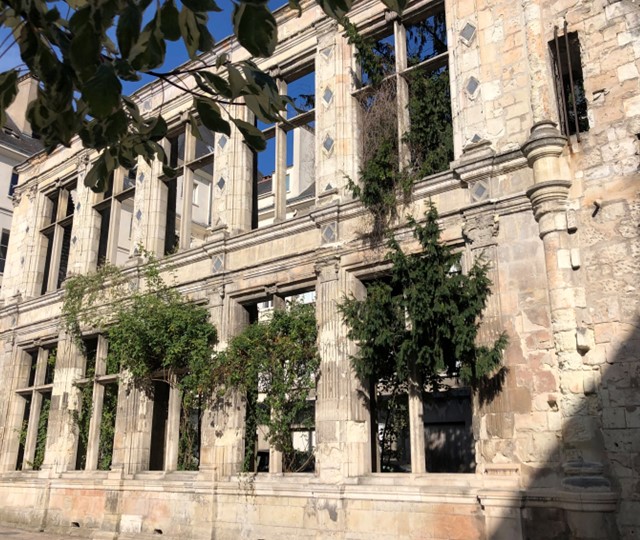
The spatial indication “in front of the hôtel of Monseigneur de Dunois” is also informative, because its location in Tours is well-known: in the Grand Rue (now rue Colbert) on the corner with the Rue Neuve (now rue Jules Favre). “Monseigneur de Dunois” refers to a descendant of Jean de Dunois (1403-1468), also known as le Bâtard d’Orléans, the illegitimate son of the prince of royal blood Louis d’Orléans. In the polarised context of the Hundred Year’s war, Jean de Dunois and his descendants remained closely connected to the French kings, hence their urban mansion in Tours.
At the time the booklist was made, the period of the Hidden Tours trail, the count of Dunois was probably François II de Longueville (c. 1481-1513), who accompanied the French king Louis XII on his Italian expeditions. The count was a high-ranking courtier and would certainly have participated in the royal entry of 1500.
A book list from Tours
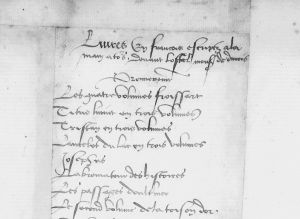
This book list with an inventory of a collection of over 267 books in Tours dates probably from shortly after 1494. Several characteristics indicate that it was the stock of a book seller specialising in second-hand books. The spatial indication “in Tours in front of the urban mansion of Monseigneur de Dunois” suggests that book seller was working from a wooden booth near the south entrance to St Julien’s church. The inventory includes a book with the Passion of Christ in French (nr. 113), the book Jehane is hunting in ‘The Passion Quest’ app trail.
Monseigneur de Dunois
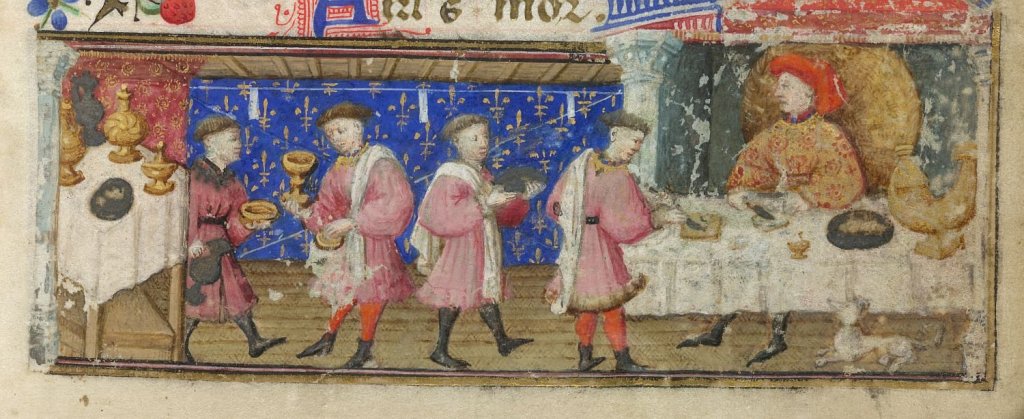
This Book of Hours was made for Jean de Dunois (1403-1468), also known as le Bâtard d’Orléans, the illegitimate son of Louis d’Orléans, brother of the French king Charles VI. In this manuscript painting Jean de Dunois is depicted heading a banquet. His royal status is underlined by the blue tapestry with heraldic lilies and the ostentatious gilded tableware, including a nef (on the table, right), not unlike the one given by the city of Tours to Queen Anne de Bretagne during the royal entry of 1500.
Margriet Hoogvliet
Further reading:
Margriet Hoogvliet, “A list of 267 French Texts in Tours: A Hub for Reading in the Vernacular”, Studi di Storia Medioevale e di Diplomatica, nuova serie IV (2021), pp. 115-153 (online: https://riviste.unimi.it/index.php/SSMD/index).
In French: “Une collection de livres en français à lire, à copier, à emprunter et probablement à vendre, à Tours vers 1500”, Publication Renumar (online: http://renumar.univ-tours.fr/publication/une-collection-de-livres-en-francais-a-lire-a-copier-a-emprunter-et-probablement-a-vendre-a-tours-vers-1500/
Geneviève Hasenohr, “L’essor des bibliothèques privées aux XIVe et XVe siècles”, André Vernet, ed., Histoire des bibliothèques françaises, vol. 1: Les bibliothèques médiévales du VIe siècle à 1530, Paris, Électre 2008, pp. 274-361.
 HistoryCity Apps