
Everyday devotion
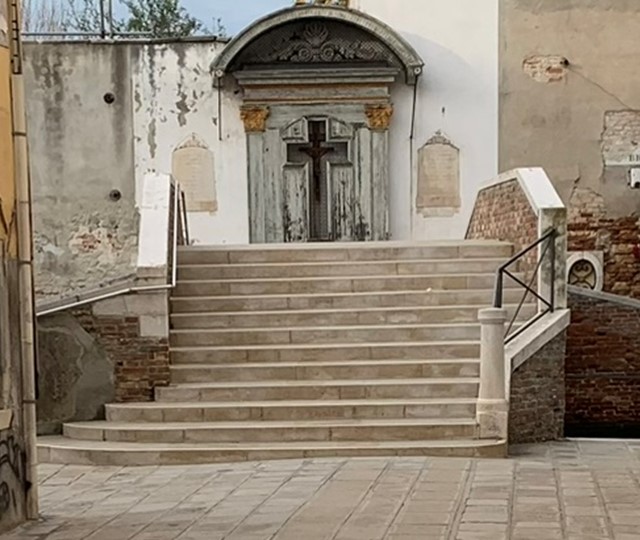
It is all too easy to overlook tabernacles or street shrines, but these were by far the most widespread devotional sites in pre-modern European cities, outnumbering the many churches. In Venice these street shrines were known as capiteli, which appears to refer to the fact that some were set up on capitals – tucked into a range of tight spaces in this cramped city – as well as on more visible street corners or other intersections where the divine gaze could reach the widest audience. Bridges, that perform the vital function of nodes in the urban network, were also favoured locations. In short, these shrines were positioned at locations where they would receive the maximum footfall, and consequently the prayers of the most passers-by. Often they were managed by the local community, who might keep a candle burning by the holy image and keep the tabernacle clean and in good order. It has even been suggested that these candles were precursors of street lighting in the pre-modern city.
These countless shrines form what can be understood as a pervasive network – a little like the CCTV networks that invade today’s urban environments – from which the divine gaze of saints, the Madonna and sometimes Christ would protect local neighbourhood communities and perhaps even operate a form of surveillance over everyday behaviour. So, for example, the much later inscriptions that flank this shrine at Ponte dell’Anzolo record a blasphemous attack on the sacred image, and warn off any future inappropriate behaviour around the site.
A famous example of a street shrine that afforded protection to a local neighbourhood is that of the Madonna dei Miracoli, an image credited to have protected a local woman from a violent knife attack which led to its widespread veneration. Such was the perceived miraculous power of that image that the beautiful church designed by Pietro Lombardo and his workshop was built to honour the painting and regulate access to it (1481-5), the church of Santa Maria dei Miracoli (in Cannareggio). Inside and out, the church is decorated with a range of coloured stone and low relief sculpture, making it appear almost like a precious casket to contain the holy image.
This was an exceptional case, but more commonly the street shrines remained sites of local neighbourhood devotion. The religious images were rarely produced by well-known artists and as such they have not been relocated to museums, so that to this day are rarely restored, but continue to retain their original function which can be seen by the fact that flowers or candles continue to be maintained by local residents.
Fabrizio Nevola
Further reading
Fiorenzo S. Cumàn, Pietro Fabbiàn, I capitèli di Venezia: arte sacra minore in Venezia, Venezia: Helvetia, 1988
Fabrizio Nevola, Street Life in Renaissance Italy, New Haven and London: Yale University Press, 2020
The Church of Santa Maria dei Miracoli: https://www.savevenice.org/project/church-of-santa-maria-dei-miracoli
 HistoryCity Apps