
Coffee shops
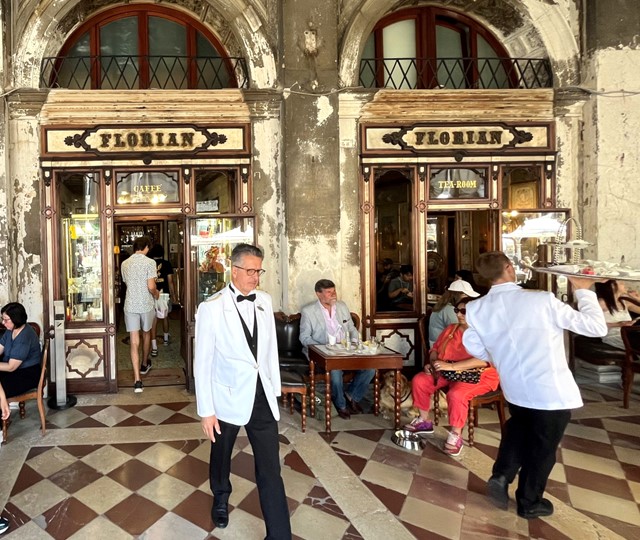
Although coffee first came to Venice as an expensive medicinal substance in the seventeenth century, by 1683 the first coffee house was established, and both the drink and the business model quickly became very fashionable. The first coffee shop was opened in one of the ground floor shops of the Procuratie Nuove, the large building lining the southern side of Piazza San Marco. Although the original caffè is gone, Caffè Florian, established under the Procuratie Nuove in 1720, is still in operation. Two other eighteenth-century coffee houses also remain under the Procuratie Vecchie, across the piazza: Caffè Quadri and Caffè Lavena. By 1750, there were more than 200 coffee shops in Venice.
Coffee shops very quickly became important sites of sociability and the public sphere, and were added to the list of places in Venice (along with the Ridotto and the theatres) where people of all different social classes rubbed elbows. This social mixing perhaps explains the tendency of coffee shop patrons to mask. Though financial means could certainly dictate the frequency with which one went to the coffee house, they offered reasonably affordable libations. Patrons could order coffee, tea, or chocolate; lemonade was often on offer in the warmer months. Many shops also sold pastries to accompany the drinks.
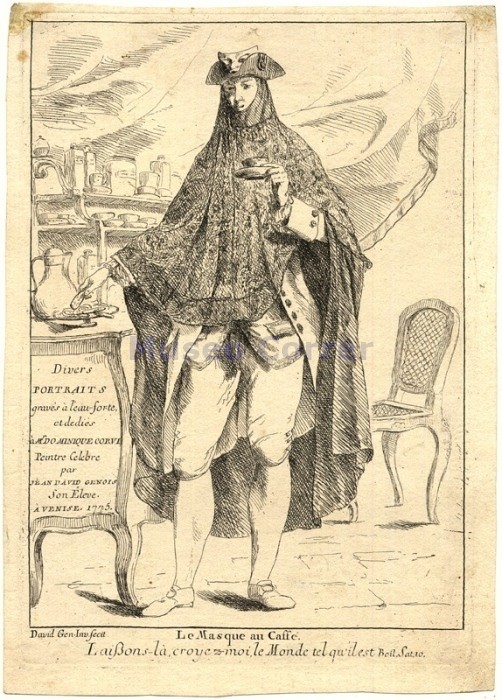
1775. Museo Correr
In addition to pleasant sociability, the coffee shop also offered access to news. In the first century of their existence, this was primarily informal; as places where many people of all different walks of life circulated, the caffè was simply a good place to hear the latest information, just like the Rialto had long been. But by the 1760s, this was formalised, with the creation of Venice’s first newspaper, the Gazzetta Veneta, written by Carlo Gozzi. Soon his paper was to be found in the major coffee houses around the city.
At the same time, there could be a seedier side to coffee houses. Any spot allowing broad socialising could breed scandal and even conspiracy or crime, and many became sites for gambling. Libertines, such as Casanova, also made coffee houses their frequent haunts. The Venetian government recognised the potential threat posed by the coffee houses, and thus spies, mostly those working for the Inquisitors of State, were often lurking around the caffè, attempting to eavesdrop on patrons. In 1743, at least partly out of a concern over the rampant gambling in coffee houses, the government issued a ban on women patronising them, a deeply unpopular and controversial decision, which seems to have been largely ignored in many shops.
Shortly thereafter, the owner of Florian petitioned the Inquisitors of State for permission to allow women to come into his caffè, promising a discreet location within the coffee house where “honest men, together with their wives and other women from their family” could be honourably accommodated. His request was granted, and thereafter the state issued a small number of similar licenses for certain coffee houses to serve women if they were in the company of a man.
Celeste McNamara
Further Reading:
Reato, Danilo. La bottega del caffè: i caffè veneziani tra ’700 e ’900. Venice: Arsenale, 1991.
 HistoryCity Apps