
End of the line for Bavaria-Landshut
After the glamorous Landshut wedding in 1475, the newlyweds Hedwig and George resided together at the castle in Burghausen, the traditional family residence of the wives and children. There the dukes’ assets were stored in a silver tower, and the castle also functioned the prison. Three years after the wedding, in 1478, the first child was born: a daughter, Elisabeth.
When Duke Ludwig the Rich died on January 18, 1479, Duke George, at the age of 24, moved to the government and administrative center at Landshut Castle as the new regent of the Lower Bavarian duchy. He hosted a large princely funeral for his father, which was not inferior to his wedding in terms of participants.
In 1480, the couple’s second daughter was born. Margarethe entered the Benedictine convent of Altenhohenau in 1494 at the age of 14 and thus began her career as a nun. By the standards of the time, the marriage of George and Hedwig was thus not a happy one, as they were unable to have a son, which was all-important for succession and the preservation of the dynasty. Their marriage produced only Elisabeth and Margarethe. Conjecture about sons who died in childhood do not stand up to much scrutiny.
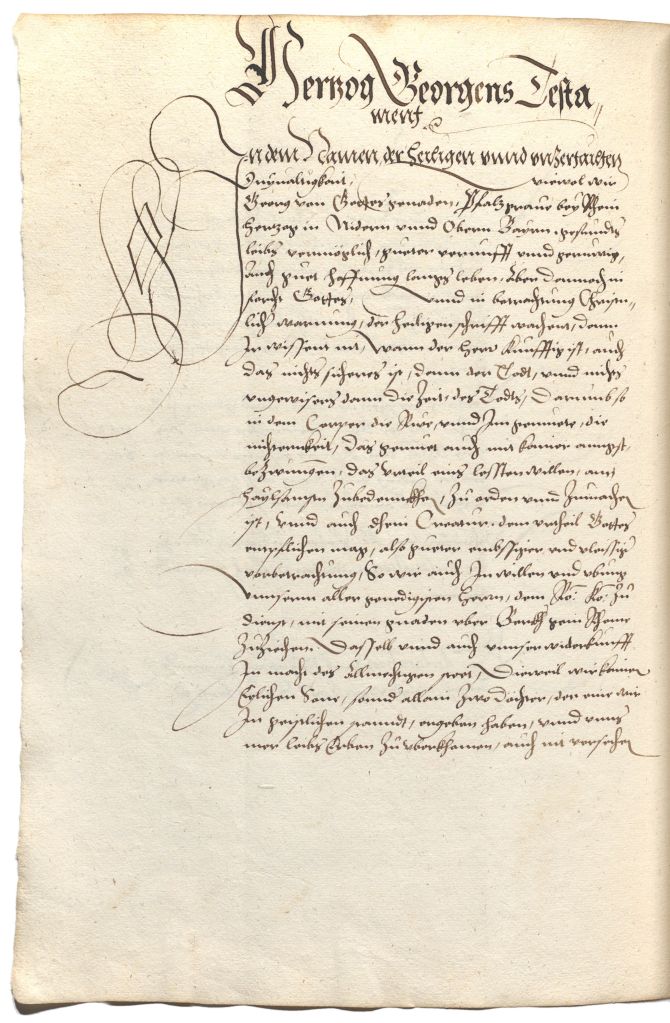
According to the Wittelsbach house contracts, however, only a son could take over the Lower Bavarian inheritance. In the event of the extinction of the Bavaria-Landshut male line, the Lower Bavarian inheritance was to fall to the dukes of Bavaria-Munich. Duke George’s attempt to appoint his son-in-law Rupprecht von der Pfalz and his daughter Elisabeth as heirs in his will failed due to the resistance of Duke Albrecht IV of Upper Bavaria and King Maximilian I of Habsburg.
Duchess Hedwig died in Burghausen in 1502 and found her final resting place in the nearby Raitenhaslach Monastery. Just one year later, Duke George died of a liver complaint in Ingolstadt Castle. In 1503, war broke out between the two Wittelsbach parties, as both Count Palatine Ruprecht and Duke Albrecht IV of Upper Bavaria insisted on their rights. This “Landshut War of Succession” was fought bitterly and devastated entire regions. It finally ended with a defeat of the Lower Bavarian Palatinate and the “Cologne Arbitration Award” in 1505: George’s grandsons Ottheinrich and Philipp received the Young Palatinate as a small inheritance, a fragmented territory in the area of the upper Danube across Franconia to the northern Upper Palatinate. The rest of the Lower Bavarian territory – the main part of Duke George’s inheritance – fell to the Upper Bavarian line with some cessions of territory to Habsburg and the imperial city of Nuremberg.
Duke Albrecht IV was thus able to unite almost the entire Bavarian territory under himself. The era of the Bavarian divisions in the House of Wittelsbach came to an end along with the line of Bavaria-Landshut.
Irmgard Lackner and Markus Schmalzl
Further reading
Rudolf Ebneth/Peter Schmid: Der Landshuter Erbfolgekrieg. An der Wende vom Mittelalter zur Neuzeit, Regensburg 2004.
Stauber, Reinhard/Tausche, Gerhard/Loibl, Richard: Niederbayerns Reiche Herzöge (=Hefte zur Bayerischen Geschichte und Kultur 38), Augsburg 2009.
 HistoryCity Apps