
Royal entries in Tours
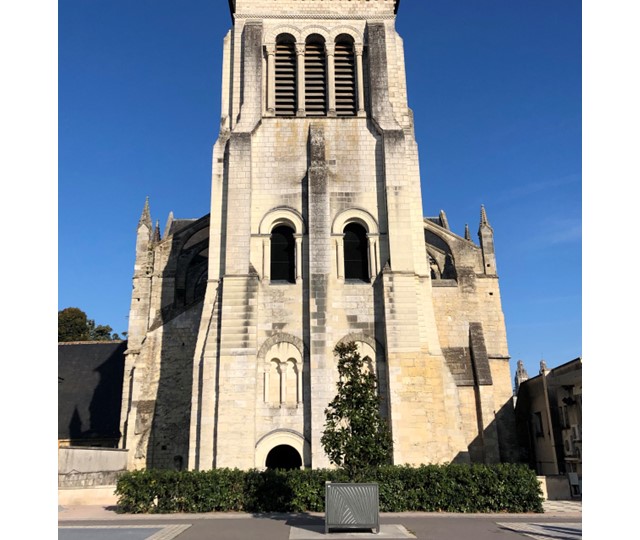
The square known as “le carroi de Beaune” was situated roughly on today’s rue Nationale near St Julien’s abbey. This square was usually one of the sites where pageants were on display during royal entries.
During the Middle Ages new rulers such as kings, queens, princes, and bishops were honoured with a special ceremonial reception when entering a city in their territory for the first time. This was originally a formal reception by the town council at the city gates, sometimes including a parade through the city. From the late fourteenth century onwards, the entries became increasingly elaborate with sumptuous decorations, tableaux vivants, temporary architecture, theatre, music, and the offering of precious gifts. Thus, royal entries became spaces of negotiation between the exercise of princely power and the confirmation of urban rights.
As the second capital of the French kingdom, Tours organised and financed numerous royal entries as accounts of expenses kept by the city council attest. For example, in 1436 the city organised festivities celebrating the marriage between the crown prince and future king Louis XI and Margaret Steward, which included a mauresque, an Orientalising dance by fantasy Moorish characters with bells and blackfaces.
The entries by king Louis XII and his new spouse Anne de Bretagne took place separately, on 24 and 25 November 1500. The royal guest was first greeted at the Porte de la Riche on the western end of the city, after which they proceeded through the city while a canopy was held over them. The route through the city usually followed the same west-east route to St Gatien’s cathedral with stops at the main city squares and in front of the town hall.
In 1500, the same pageants were put on for the King’s entry and the Queen’s the following day. Some were very elaborate. For example, upon entering the town from the west at the Porte de la Riche, the King and Queen were presented with a mystery play evoking the legendary founders of the city of Tours, Turnus and Hugo, together with personifications of three virtues: Faith, Hope, and Loyalty. This message was addressed simultaneously to the King, Queen, and the urban population. The pageant included a display of the city’s arms, music, tapestries and freshly cut greenery. Most included text panels and scrolls with poetry referring to the mythological, biblical, and allegorical figures on display, thus inviting the public to read them.
The city spent the enormous amount of 2,854 livres tournois on this royal entry, not least on extravagant gifts for the king and queen. The king was gifted with a golden bowl with 60 golden medals, and the queen received a spectacular nef, a decorative table vessel, made from the semi-precious gemstone carnelian, gold, and silver.
Gold medal with Louis XII
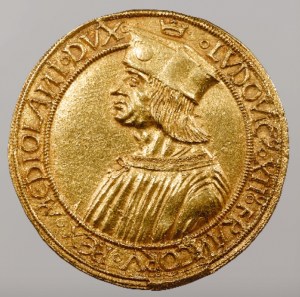
A golden bowl and 71 golden medals were made as a gift to king Louis XII for his royal entry into Tours. The medal was designed by the famous Tours-based sculptor Michel Colombe. One side of the medal shows the king wearing a hat with medal and the Latin inscription “LVDOVIC XII FRANCORV REX MEDIOLANI DVX” (Louis XII, king of the Franks, duke of Milan). The other side has the king’s personal emblem of a crowned porcupine, now standing on three towers referring to Tours with the classicising Latin text “VICTOR TRIVMPHATOR SEMPER AVGVSTVS” (Triumphal conqueror, always majestic). “Augustus” can also be read as a reference to the Roman emperor Augustus.
Triumphal entry by Louis XII
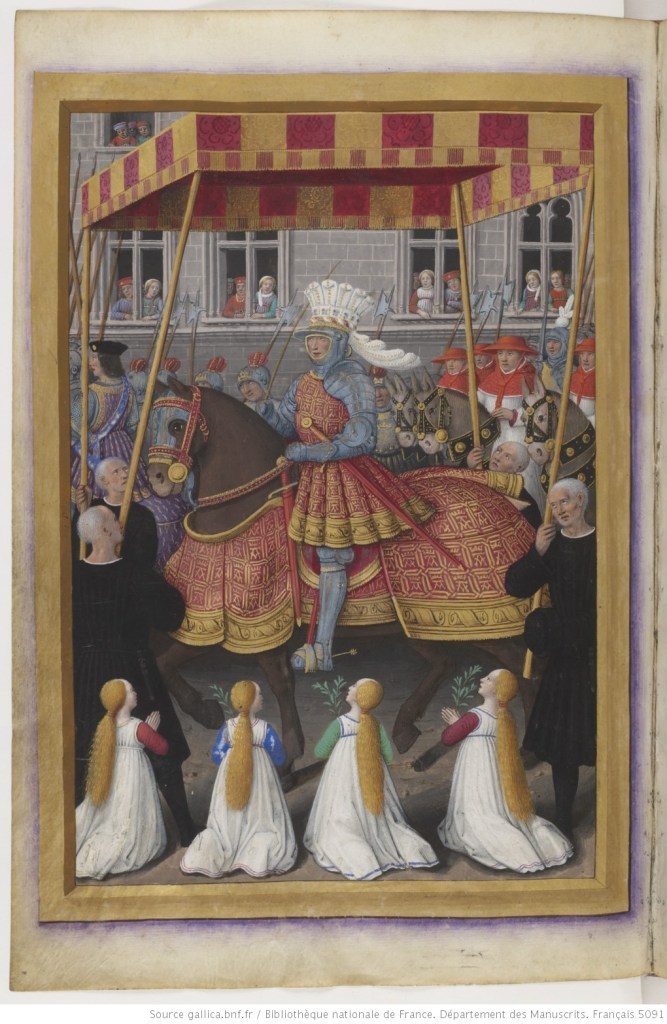
Apart from a list of payments by the city council, no visual documents survive that help us imagine what the royal entry of Louis XII and Anne de Bretagne into Tours in the year 1500 looked like. This manuscript painting was made by the Tours-based painter Jean Bourdichon in the early sixteenth century. It accompanies a text by Jean Marot recounting the victory of Louis XII over Genoa and his triumphal entry into the city in 1507. It translates the ideological perspective of the French monarchy: a richly adorned and venerated king-hero entering a city that subjects itself to him. The kneeling virgins with olive branches represent the subjugated population, while the branches are a reference to Christ’s entry into Jerusalem on Palm Sunday.
Margriet Hoogvliet
Further reading:
Bernard Guenée et Françoise Lehoux, Les Entrées royales françaises de 1328 à 1515, Paris, Éditions du CNRS, 1968.
David Rivaud, Les villes et le roi Les municipalités de Bourges, Poitiers et Tours et l’émergence de l’État moderne (v. 1440-v. 1560), Rennes, Presses universitaires de Rennes, 2015, pp. 207-239.
David Rivaud, ed., Entrées épiscopales, royales et princières dans les villes du Centre-Ouest de la France XIVe-XVIe siècles, Geneva: Droz, 2013.
Neil Murphy, Ceremonial Entries, Municipal Liberties and the Negotiation of Power in Valois France, 1328-1589, Leiden, Brill, 2016.
 HistoryCity Apps