
Minorities and the Venetian ‘scuole’
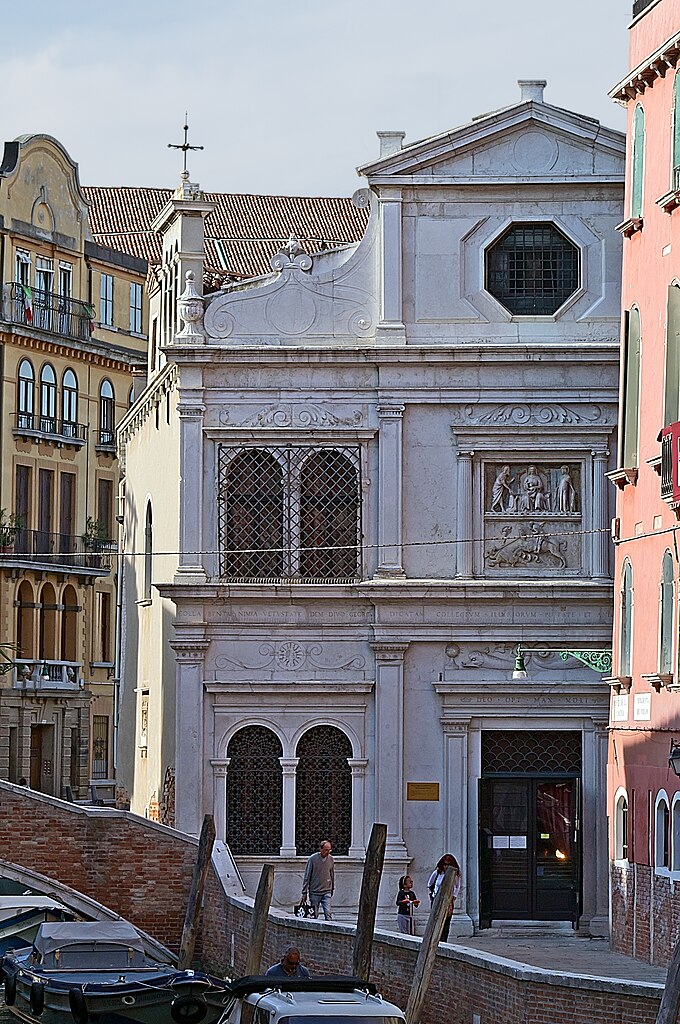
The schiavoni were another significant foreign group in the city. These migrants came from Dalmatia, now in Croatia, much of it part of the Venetian maritime state since the fifteenth century, and they often worked as sailors, shipbuilders, or merchants. (They gave their name to the Riva degli Schiavoni, where the ‘City of Refuge’ trail begins.) Like other migrants, they also found low-paid jobs as domestic servants, some arriving in Venice as indentured workers, a legalized form of semi-slavery.
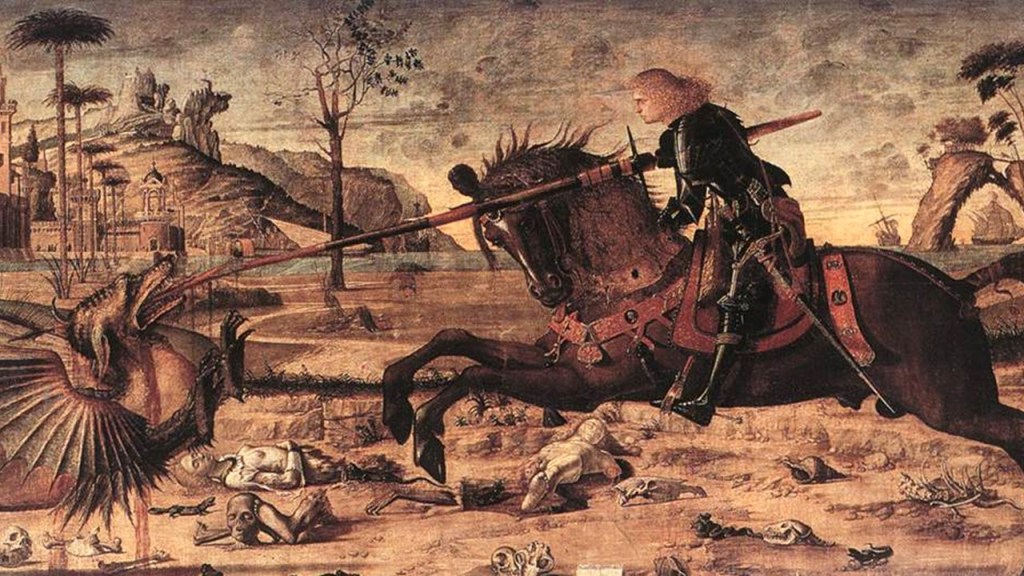
The Dalmatian community received permission to found its own scuola in 1451 and by the early sixteenth century had had this building constructed to house it. At the same time, the scuola commissioned the leading Venetian painter Vittore Carpaccio to produce images of its patron saints, Augustine, Jerome, George, and Tryphon. These are some of the finest Renaissance paintings that can still be visited in their original site, inside this building.
There were over two hundred religious confraternities or scuole piccole in Venice by the sixteenth century, which provided important gathering points for laypeople to practice devotional rituals and charitable activities. Some were associated with certain professional trade guilds while others were formed by foreign communities, including the Albanians in 1448 and the Greeks in 1498. From the government’s perspective, these organizations helped to promote the social integration of migrants while also allowing some degree of surveillance over them. But they were also very important sources of mutual support and community identity for both newly arrived and more settled migrants. The scuola might assist newcomers in finding accommodation and work and offer opportunities for members of the community to gather informally and celebrate religious rituals in their own language.
Although these kinds of organizations promoted a sense of collective identity among migrant communities, extending across generations, the realities of life and work in Renaissance Venice meant that most migrants integrated fairly quickly into Venetian society. Mixed marriages between foreigners and locals, or with members of other foreign groups, as in the case of Elena’s friend Anna in the app trail, were fairly common, and were one of the simplest routes to integration.
Next door to the confraternity building of the schiavoni was the headquarters of the military order of the Knights of Malta. Until the mid-fifteenth century, this order also oversaw a hostel for pilgrims passing through Venice on their way to the Holy Land. Many pilgrims would spend several weeks in Venice as they prepared to depart for the east, stocking up on supplies and organizing their onward transport. As well as dedicated hostels, they might stay in inns or lodging houses. By the mid-sixteenth century, however, this flow of visitors was decreasing, also because of the wars with the Ottomans in the Mediterranean.
Rosa Salzberg
Further reading
Francesca Ortalli. ‘Per salute delle anime e delli corpi’. Scuole Piccole a Venezia nel tardo Medioevo. Venice: Fondazione Giorgio Cini/Marsilio, 2001, pp. 102-110.
Robert C. Davis, and Garry R. Marvin. Venice, the Tourist Maze: A Cultural Critique of the World’s Most Touristed City, Berkeley, CA: University of California Press, 2004.
Brunehilde Imhaus. Le minoranze orientali a Venezia, 1300-1510, Rome: Il Veltro, 1999.
 HistoryCity Apps