
At the hub of world trade
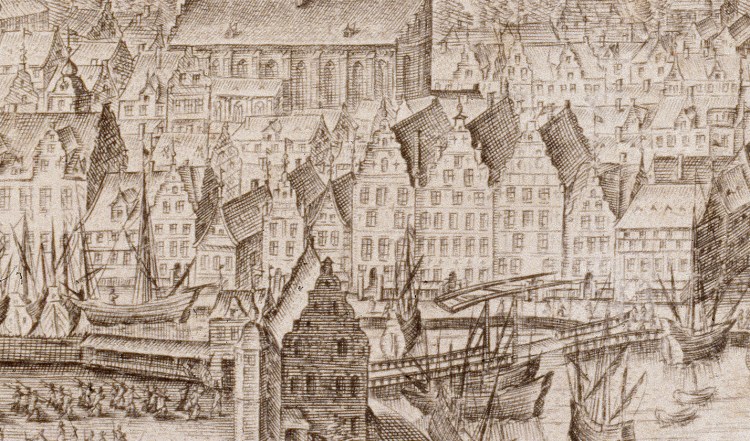
Gammel Strand (Old beach) is the old harbour of the city. Until the 1700s, the area was called Ved Stranden (By the beach), and since the Viking Age, ships have come here to sell and buy goods. Copenhagen means the Merchants’ Harbour, and harbour and trade have had a decisive influence on the city’s development.
The wrecking pier and weighing house were located on Gammel Strand. Here goods from all over the kingdom and far away were quality checked and weighed on the city’s scale. The goods were repacked and stored until the merchant or shipowner collected them. In the many drinking stalls, sailors and others could be served a mug of ale – along with news from the wider world and local gossip from the town.
The oldest trading company in the kingdom was also based here, and many of the city’s wealthy owned properties and ornate courtyards by the harbour – just across from the King’s castle, which stood where the parliament building Christiansborg is today. On the waterfront in front of the castle was the customs house. Their ships had to pay duty on their cargo to the King and pay accise – a tax on particular goods that accrued to the city.
Initially, the harbour between Gammel Strand and Christiansborg was much broader. The present-day canal is just a remnant of what was once open sea water. In the early 1500s, the sea extended almost as far as the row of houses along Gammel Strand. Slotsholmen with Copenhagen Castle was just a tiny island lying out in the water.
In 2012-14, archaeologists were allowed to dig in the old harbour area for the metro station on Gammel Strand. The excavation revealed row upon row of wooden bulwarks forming the quayside from the Renaissance (1536-1660) to the present day. When a bulwark rotted, a new one was put in front further out in the water. The space between the old and new bulwarks was filled with the town’s rubbish, which also gave more quay space. Everything from latrine waste and animal dung to household rubbish such as leftovers, cut-up pots, broken plates, and old rags was used to fill up. The rubbish gives us a unique snapshot of life in the capital, revealing what people ate, how they dressed, and what they surrounded themselves with.
But the remains of many more delicate and exotic objects have also been found in the soil. From the early Renaissance in the 16th century, imports typically came from the Netherlands and Germany. But in the 17th century, world trade set sail, which is reflected in the archaeological finds—wine glasses from Italy, oil jars from Portugal, and porcelain from China. Voyages of discovery had opened doors to a new world in America, Asia, and Africa. Chipped cups reveal that luxury goods such as tea, coffee, and chocolate found their way to Copenhagen in the late 17th century and gnawed bones in the rubbish show that the newly discovered turkey from America had also reached Copenhagen’s dining tables. A rare find is a gold ring with an emerald from Columbia.
Today there is little evidence that Gammel Strand was for centuries the center of Danish world trade and the busiest port in the Danish-Norwegian Kingdom. The statue of the fisherwoman was erected as a memorial to the time that followed, when the harbor was transformed into a fishing square, with fishing boats packed side by side in the canal and fisherwomen shouting as they hawked fresh fish to passers-by.
Rikke Simonsen
Further reading
Permanent exhibition “The Great World” at Copenhagen Museum about the city’s trade in the Middle Ages and Renaissance.
Kirstine Haase & Stuart Whatley: Consumption Strategies and Social Implications in Two Danish Towns in the 13th–16th Centuries, Medieval Archaeology, 64:1, 2020,116-144
Stuart Whatley: The Medieval and Early Post-Medieval Weighing Houses at Gammel Strand, Copenhagen, Denmark, Buildings of Medieval Europe. Studies in Social and Landscape Contexts of Medieval Buildings, Oxbow Books, 2018, 29-48.
 HistoryCity Apps