
‘Another Byzantium’
The cultural contribution of the Greeks to Venice was considerable. The fall of Constantinople to the Ottomans in the mid-fifteenth century spurred numerous Greeks to visit or migrate to Venice, some of whom became prominent figures in Venetian intellectual life.
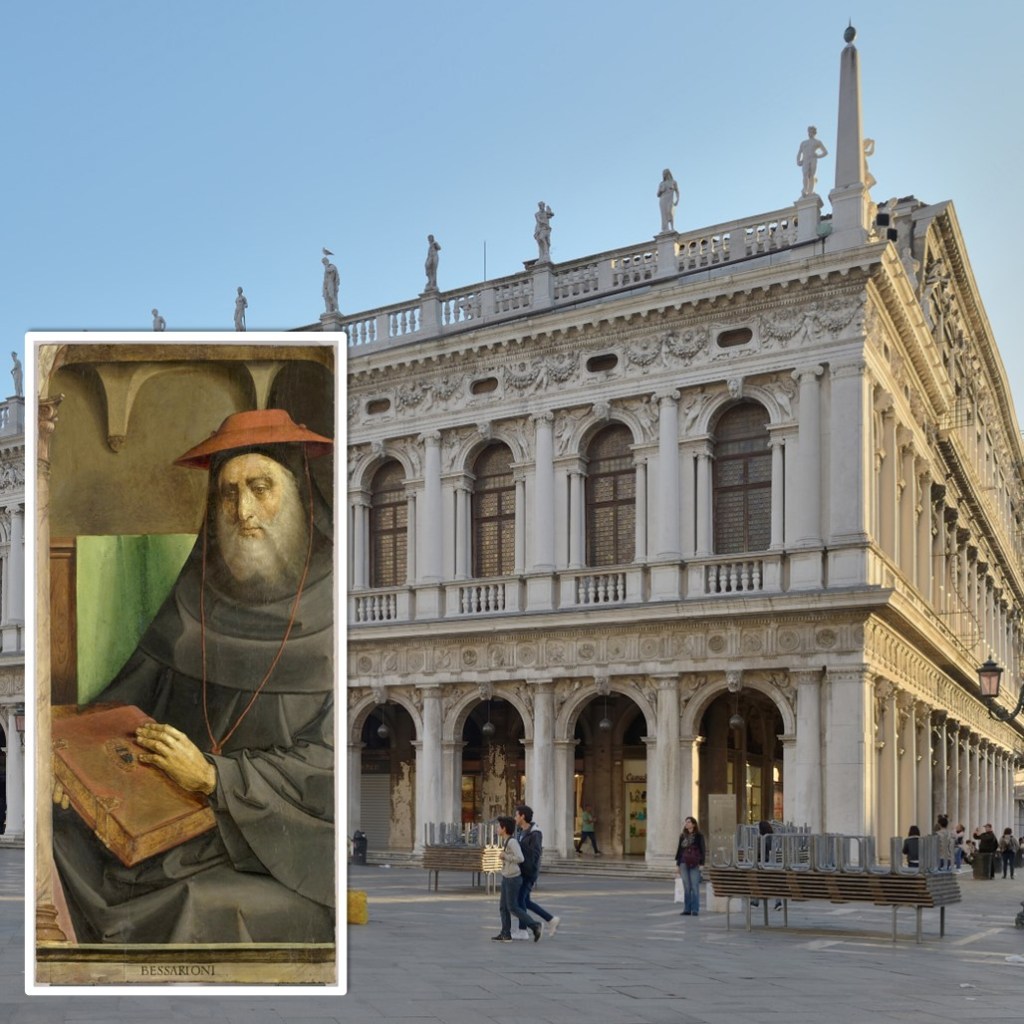
The Greek Cardinal Bessarion, for example, visited the city around 1460, and later decided to donate his precious library of Greek and Latin manuscripts to Venice. “Though nations from almost all over the earth flock in vast numbers to your city”, Bessarion wrote, “the Greeks are most numerous of all”. This made Venice feel like “another Byzantium” and the best hope for preserving Greek culture in the west. The donation was made on the condition that Venice build a library to house the books. Although this would take around a century to achieve, in 1537, the architect Jacopo Sansovino began construction of the magnificent neo-classical Marciana library in Piazza San Marco, still in operation today.
Greeks also played an important role in the burgeoning printing and book trades in Venice, working as authors, printers, correctors, and bookbinders especially of Greek texts. In the late fifteenth century, the Cretan Zacharias Calliergi founded a press that printed only Greek works. He did this with the financial support of a wealthy fellow Cretan, Nicolaos Vlastos, and of Anna Notaras Palaiologina, a Byzantine noblewoman who had come to Venice as a refugee in 1475. Other Greek intellectual emigrés included Janus Lascaris and Marcus Musurus, who taught Greek language at the University of Padua and in Venice. These scholars became part of the circle of the Italian scholar-printer Aldo Manuzio, who started his press in Venice in the 1490s and became famous for producing some of the most beautiful and accurate editions of classical texts in the original Greek. Such figures helped to make Venice a centre of humanistic culture and printing.
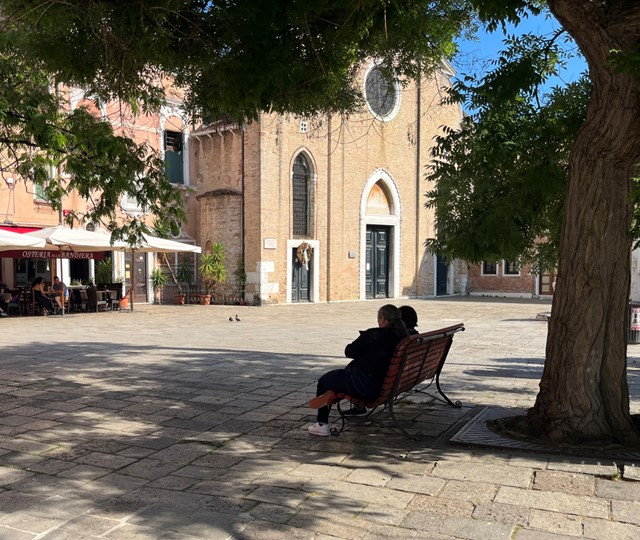
The printing business was also among the numerous commercial investments of members of the Cuvli family of merchants, originally from Elena’s hometown of Nauplion. In the late sixteenth century one branch of this large and prominent Greek family moved into the Palazzo Cuvli (now Palazzo Salvioni) just near this square.
Malvasia is the name given to a group of white wine varieties imported from the Morea (or Peloponnese) region in Greece which were very popular in Venice in this period. A calle (street) della Malvasia which runs behind this square testifies to the presence of a shop specializing in these wines in the past. These were popular drinking establishments for Venetians of all classes and their numbers were proliferating in the sixteenth century, to the point where in 1572 the malvasia sellers of Venice were granted permission by the state to be able to form a professional guild.
Rosa Salzberg
Further reading
Ersie C. Burke. The Greeks of Venice, 1498-1600. Immigration, Settlement, and Integration. Turnhout, Belgium: Brepols, 2016.
David Chambers and Brian Pullan, eds. Venice: A Documentary History 1450 – 1630, Oxford: Blackwell, 1992, pp. 357-58.
Michela Dal Borgo and Danilo Riponti. “Malvasia un vino tra legislazione, commercio e diffusione nella Repubblica di Venezia (secoli XIII-XVIII)”, in Carlo Favero, ed., Il vino nella storia di Venezia. Vigneti e cantine nelle terre dei dogi tra XIII e XXI secolo, Cittadella: Biblios, 2014, pp. 218-33.
 HistoryCity Apps