
Government and urban society
In 1180-81 the inhabitants of Châteauneuf, the western urban centre of Tours were successful in obtaining official permission from the French king Philippe Auguste to elect a council of ten wise men (prud’hommes): legal rights which implied administrative autonomy of the urban community.
The Hundred Year’s War and the need to defend the city against the English troops offered new possibilities for securing more urban privileges. New city walls were urgently needed in order to protect Châteauneuf together with the second urban center les Arcis near St Gatien’s cathedral. On 30 March 1356, the French king Jean II le Bon granted the inhabitants the right to have a municipal council of six, later two men (les élus), representing both centres, with the authority to levy taxes for the construction of the city walls and for management of the urban budget.
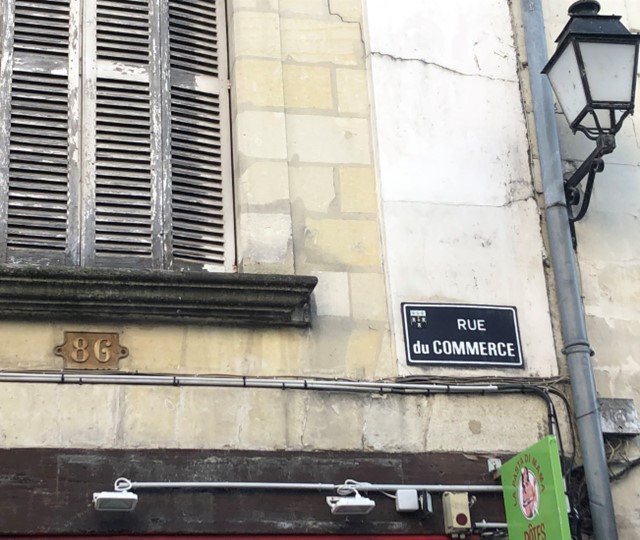
During the years that followed the city succeeded in obtaining more liberties and privileges from the French kings. Starting in 1417 the city council consisted of a commission of twelve men representing the urban population and the clerics. For housing the urban administration and in order to have a meeting place for the city council, two houses in the Grand’Rue near the cloth market were purchased in 1467 (situated at the site of 84 and 86 rue du Commerce). On the street side the town hall looked like just two urban houses, but the space behind the facade was quite large and included a vast meeting hall on the first floor.
The town council levied taxes, kept a detailed administration, and managed all kinds of activities, from building the city walls, assuring the defense of the city, assuring local justice, financing sermons, and organising a Latin school.
The presence of the royal court in Tours offered the urban population many possibilities for social climbing. Personal contacts with the kings allowed a few rich merchants to obtain important positions in the kingdom’s governance and financial administration. For artisans, too, the royal presence offered many possibilities, for example, specialising in luxury objects for affluent clients, such as harnesses, silk purses, richly decorated books, or multicolour stockings with silk velvet. During archaeological excavations in 2002 near the Loire’s riverbanks late medieval scissors, a hat, leather shoes, and textile fragments for stockings were found in a former trash pit.
Wax seal of the city of Tours
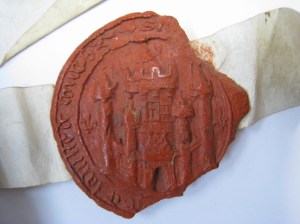
The use of a seal functioned as an official signature and implied that the city was a legal entity. In the course of the centuries the city council of Tours used several different seals. This example from 1499 consists of a walled tower, showing the strong defense of the city and a reference to its name: “une tour” is a tower in French. The heraldic lilies on both sides represent the city’s identification with the monarchy.
All along the watchtower
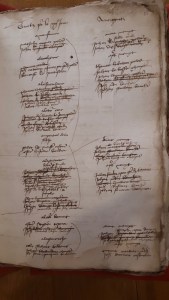
In order to protect the city of Tours it was necessary to be continuously on the watch from the city walls. Even after the official end of the Hundred Year’s War, companies of former soldiers were a continuous threat. The night watch on the city walls was organised by the city council, who made public lists of the duty men (mostly artisans), together with their positions on the walls. This list from 1465 survives in the account books of the city council. Containing almost 900 names, it gives a unique insight into the city’s artisans and their occupations. Included is the famous painter Jean Fouquet, as well as 30 stocking makers.
Margriet Hoogvliet
Further reading:
David Rivaud, “État du guet à Tours en 1465 : présentation du document et analyse sociale”, Online publication: http://renumar.univ-tours.fr/publication/etat-du-guet-a-tours-en-1465-presentation-du-document-et-analyse-sociale/
Bernard Chevalier, Tours, ville royale (1356-1520): origine et développement d’une capitale à la fin du Moyen âge, Leuven, Nauwelaerts, 1975
Hélène Noizet, La fabrique de la ville : espaces et sociétés à Tours (IXe-XIIIe siècle), Paris, Publications de la Sorbonne, 2007.
Henri Galinié, ed., Tours antique et médiéval. Lieux de vie, temps de ville. 40 ans d’archéologie urbaine, Tours, FERACF, 2007.
Jean-Luc Porhel, « Aménagement et décor du premier hôtel de ville de Tours, autour de 1500 », Marion Boudon-Machuel, Pascale Charron, réd., Art et société à Tours au début de la Renaissance, Turnhout, Brepols, 2017, pp. 29-39.
 HistoryCity Apps