
‘The return of the merchant’

May, 30, 1881. Adamo returns after many years to Pieve Tesino, where his elderly mother still lives.
Like most men from Tesino, Adamo, now 44, has travelled the roads of Europe. First in his father’s wake since the age of 12, then as a travelling print dealer, and later in a family-run shop established in Paris.
He has sold all types of prints, ranging from those produced by the Remondini in Bassano del Grappa to more modern chromolithographs and oleographs – devotional images, biblical scenes, portraits, hunting scenes and genre pieces.
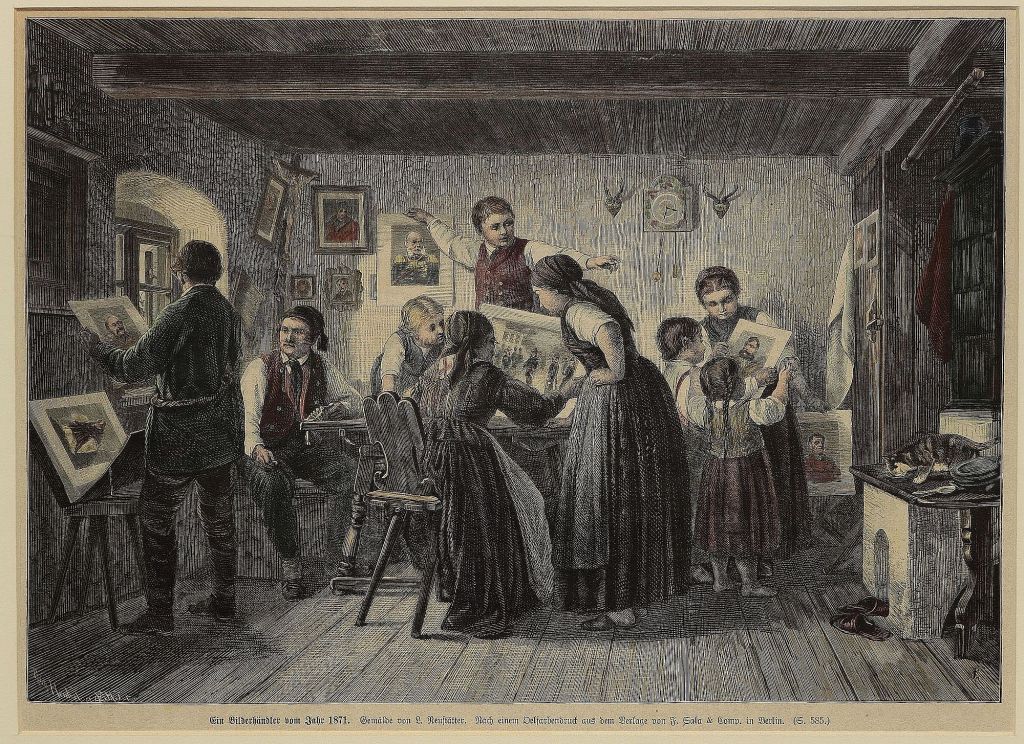
The character of Adamo is inspired by the Tesino men who, between the 17th and early 20th centuries, became key figures in the itinerant print trade across Europe and beyond. Adamo embodies their life stories, drawn from archival documents and oral accounts, as well as images and photographs. Through his voice, the protagonists of this epic saga speak.
In the trail on the free Hidden Pieve Tesino app, Adamo awaits you in Piazza Garibaldi (formerly Piazza Vaon), a few steps from Museo Per Via, a museum dedicated to the history of Tesino’s travelling salesman and merchants and home to a remarkable collection of prints. In 1881, the museum was the residence of the Buffa-Giacantoni family of local traders and farmers. Adamo will take you to Piazza Maggiore, the Hotel Tesino, the parish church of Santa Maria Assunta, the hill of San Sebastiano, and finally Villa Daziaro, built by two merchants who made their fortune in Russia.
The brief articles in these webpages expand on the app audio, and dive deeper into the locations and historical context at each of the six sites on ‘The return of the merchant’ trail.


