
A platform for location based learning
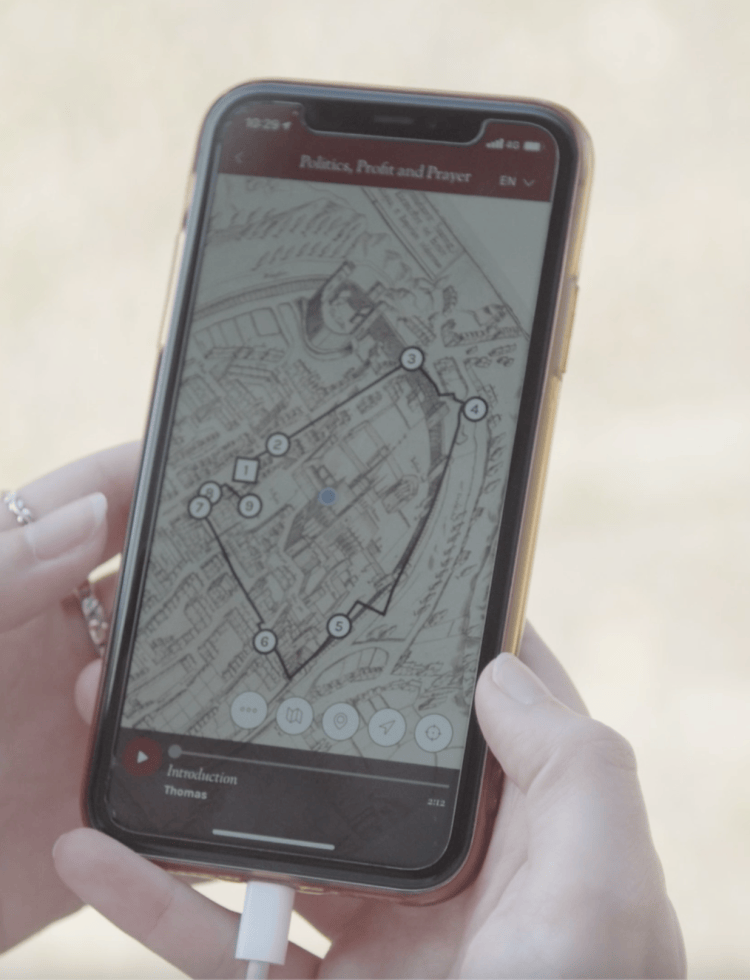
The teaching version of the HistoryCity platform offers a unique opportunity to do place-based interpretation inside and outside the classroom through group work that engages students with places, objects, and the social and cultural histories that give them meaning. Building app trails builds skills in critical humanities, public history and heritage, and assembling mobile multimedia projects. This short video outlines our methodology.
The teaching app has to date been used in courses at the University of Exeter, Venice International University and Ca’ Foscari, and Duke University in North Carolina. It has most of the same features as our published apps. It can be supplied as part of a new city or regional app project, or as a small standalone package with academic and technical support.
For more information get in touch with the HistoryCity team: Fabrizio Nevola and David Rosenthal.
What people say
HistoryCity supports new pedagogies that challenge students to reconsider who constitutes the subjects and authors of history. It provides a unique experience, encouraging students to go beyond the book and explore the site itself. We used the app to help students research a neighborhood of Chicago architecture, where they could use historical newspapers and other sources to build out a fascinating story of urban history. I would recommend this tool for any educator looking to tell a people-centric story about our built environment.
— Paul Jaskot, professor of art, art history & visual studies, Duke University, North Carolina
HistoryCity has transformed the way we teach the Field Study module in Art History and Visual Culture at Exeter. It provides an innovative and engaging way of preparing students for our trip to Florence. Students become active researchers and interpreters of the city and its culture before they arrive, using HistoryCity to create their own character-based digital trails. In the process, they deepen their knowledge of Florence’s rich and layered history, whilst also developing key skills in research, translating scholarship into compelling narratives, and digital literacy. By building their apps before the trip, students arrive in Florence with a much deeper investment in its places, communities, histories and stories — and with the opportunity to see their academic work come alive on the ground.
— Jamie Edwards, senior lecturer in art history and visual culture, University of Exeter
I really enjoyed this project because it allowed me to look at part of my daily life in Venice in a different perspective through a historical lens and it allowed me to form a stronger connection to the city and to the public spaces it holds.
— History and Politics undergraduate, University of Exeter
The app framework challenged us to articulate academic research into a more creative format which is more accessible for the public. The most exciting aspect was the ability to test our research on location and later share this with friends via a QR code.
— History undergraduate, University of Exeter

